A Dancer's Dancer
Interview, September 2007
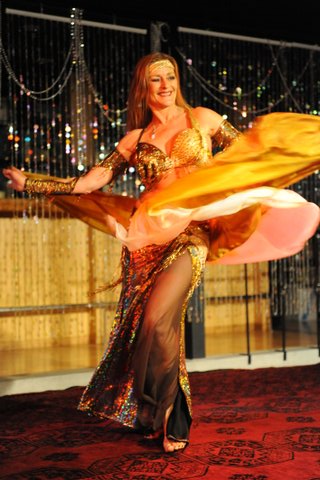
Hadia, an internationally acclaimed Oriental dancer and is known by those in business as a dancer's dancer. Although she focused on performance during the first 25 years of her career, she is now primarily devoted to teaching and passing on a lifetime of learning to HER students. This gives her the opportunity to work and dance for dancers - her favorite audience: "That's when all the stops come out and something magical happens."
Growing up in Saskatchewan, Hadia danced because she loved it, but dance classes were neither available nor an option. Later she moved out to Vancouver with her family and as soon as she started university, she immediately signed up for jazz and modern dance classes as extra curricular activities after seeing the sister of one of her friends performing at a concert and consequently being informed that "anyone" could attend the classes. Shortly afterward, a friend of hers invited her to join a belly dance class. Although she had not the slightest idea what that might entail, she was immediately intrigued by the round, smooth quality of the movement. She happily traded in her modern classes for a variety of belly dance classes with local teachers. After about 2 years of classes, she went to a workshop by the legendary Badawia of Jordan, and underwent a radical and inspirational quantum jump and became in her words "an instant belly dance addict”.
She never had any plans to BECOME a dancer, but felt that she had not choice BUT to dance and to Learn to dance, every free moment that she could find. She never hesitated to pursue her teachers anywhere in the world.
She made frequent study trips to Oregon and California. During one such trip she had the good fortune attend a workshop taught by Ahmed Jarjour, a Lebanese Canadian dancer from Montreal.
Hadia had another life altering moment during this workshop while following his "wonderful, luscious diagonal undulation" for about 15 minutes. It was really a "physical, emotional and even cellular experience." Her previous West Coast mentality was transformed with her first taste of Egyptian Oriental Dance and she went off to Montreal to study with him as well as the legendary Bobby Farrah in New York. Fueled by an insatiable desire to discover the roots of this beautiful and life altering dance, Hadia left for Turkey, Egypt ad North Africa to begin a lifelong journey.
The only dance classes in Egypt at the time were through the two national dance companies. The only way to study with most dancers at that time was to go out and to watch them perform. Ironically, she absorbed the music, dance, and culture of the Middle East by studying with Nadia Gamal, Mona al Said, Ibrahim Akef, Farideh Fahmy, Dina, and many others afterwards in her career.
When I asked her how she could manage to travel so extensively to pursue her dance training, she explained "It was a different time – a time of plenty," Hadia says, "We could just quit our jobs and leave for adventure, knowing that there were many more jobs to be had when we returned. It was also much more affordable to travel through and live in many of the oriental and Mediterranean countries. Today we live in a much more difficult and limiting economic reality."
She also worked in the Middle East, but found it to be extremely difficult. She quickly discovered that it was hard to maintain ones integrity and dignity in a culture that automatically considers a dancer to be a prostitute. But, there were wonderful artists and a large Arabic population in Europe so she refocused her performance career there, as she had a chance to work with good artists and still have a normal life."
While living in Spain for several years, Hadia studied with many of Spain's Flamenco masters - for 5 to 6 hours a day – 5 days a week. Although she worked as professional flamenco dancer for many years, she eventually began to explore oriental flamenco fusion. Although she believes that the evolution of all dance is essentially the result of successful "fusion that works", she also feels that it is important to understand and study the forms being fused to avoid "confusion". Fusion blends elements to the appropriate music and explores connections and contrasts. Fusion is not something that is simply made up without respect to cultural context or artistic integrity of the elements fused. Hadia will bring that philosophy to her Oriental and Flamenco fusion workshop at Cassandra's College. It's substantial, she admits, but students will get a good understanding of how it's done through her skillful teaching: she will "tone it down," use repetition, and show us how to use our bodies. But, she says, "We have a whole day to work with choreography." She assures us that it's okay to learn fusion without knowing Flamenco.
As dancers who have chosen to be involved in an art form with a cultural context, we have a responsibility to the culture as well as to the art. "It's up to us to demand excellence and accuracy of information from our teachers as well as our performers" Hadia believes that playing dress up and doing whatever we like is not the way to attempt to have Middle Eastern dance recognized as a legitimate art form, nor is it a viable approach to establishing a reliable and repeat audience.
Near the end of her time in Europe, the economy was shifting. Fewer performance opportunities in all fields of the arts, combined with a rapidly increasing interest in Oriental dance combined to create a degenerating situation with more competition, undercutting and challenges and less respect. She decided that she preferred to start a new career before loosing track of all the reasons why she loved the dance so much. She returned to Canada to begin an intensive three year program of study to become a Registered Massage Therapist which included anatomy, kinesiology, physiology, and osteopathy. It was truly amazing to learn how the movements that she had done for so many years were actually created. This awareness inspired her to rework many of the basics of her own dancing and also created an entire new dimension to her teaching, as she was able to explain to them much more clearly HOW to find and do the movements. She also discovered that if one is aware of exactly which muscles do what action, we don’t use all the muscles in the general area. Our dance becomes not only much simpler, but more relaxed and energy efficient, which is a really an important key to understanding the quality of Egyptian oriental “total relaxation with specific.
Also as a therapist, Hadia understands the amazing healing power (physically and emotionally) of this art form. Unlike many other dance forms that she has practiced, such as jazz, ballet, Flamenco and African dance, oriental dance has almost no potential for injury if practiced correctly from a position of optimal alignment (posture). She has actually been able to “undo” many of the injuries that she acquired after decades. No pain – no gain is definitely not a wise approach to body care and she advises "If it hurts, don't do it!" Pain is there to warn us that we are actually injuring our bodies.
Hadia loves creating and teaching choreographies, as they are such wonderful tools to transmit the instructors understanding of the musical components (rhythms, instrument, phrasing, and dynamics) to the student in an accessible manner. However, they are not particularly useful unless the students are able to do the necessary techniques and movements and to understand how these are relevant to the music. She believes it is far more important for the students to really understand and to be able to perform a section of choreography well, than to just follow a complete choreography without really understanding the elements and techniques involved. She admits that she teaches "pretty meaty stuff," and won't move on until the majority of students have learned the movements properly. This will then give them very valuable tools which they can use to build their own choreographies or even apply in improvisation. In the words of one of her much loved teachers, "Do you want to learn how to dance, or do you just want to learn another dance?"
Hadia and Cassandra met in 1989 in Vancouver when Cassandra was teaching a workshop. "Cassandra's a vanguard in this industry," Hadia says, "She pursues and presents this dance as it should be. To be recognized and invited by Cassandra is an honor." The respect is mutual. After seeing one of Hadia's performances, Cassandra told her how moved she was, which brought tears to Hadia's eyes.
Hadia now lives in Montreal, teaching dance and post-graduate seminars in massage and manual therapy techniques. Reflecting on how dance has become big business in the past few years, she reminds us what it's all about. "If you love to dance with all your heart and soul, and do it because you have to do it, then it will provide a way for you." A dancer's dancer, indeed.
A Day with Hadia
Before actually meeting Hadia in person, I had already heard a lot about her; that she is a fabulous dancer, and someone that I must train with if I was serious about learning Middle Eastern dance.
Back in May of 2001, I had just uploaded my website and sent Hadia a personal invitation by email to view the site. Her immediate response was, “Who are you? And why are you writing to me?” I was surprised that I actually received a response from her as she had thanked me for the invitation and sounded genuinely interested.
Then later on in July, while Hadia was in Victoria taking a workshop from one of her favourite flamenco instructors, Maria Bermudez from Jerez, Spain, I had the opportunity to meet her. In the following few months, we continued to correspond via emails until Sabah (my teacher at the time, and long time student of Hadia’s) convinced me to find a way to study with Hadia. I had no idea how I was going to manage to get out there and study with her, but I knew that I had to.
Not long after, I found myself in her office, wearing an invisible ‘Hadia’s Assistant” nametag, and sending her C.V., bio, and schedule all over the world to sponsors that have booked her for workshops and performances. While sending out these items, I had a chance to REALLY read her bio and was amazed at how much she has accomplished.
The list of Middle Eastern dance teachers she has studied with includes the Badawia of Jordan, Ibrahim Farrah, Ahmad Jarjour, Nadia Gamal and Raqia Hassan. She has performed and instructed throughout North and South America, Europe, the Middle and Far East, Hong Kong, New Zealand and Australia….places I have only seen in an atlas.
Her upcoming bookings include; a two week residency (March 3-17) in Toronto for Yasmina Ramzy’s Arabesque Academy, Vancouver on April 6th and 7th (if you haven’t already registered, contact Senitza right away as it is filling up already!). Then there’s Eugene (Oregon), the Maritimes, Alaska, Utah, Georgia, Greece, Belgium, Paris, Nelson, Texas, Missouri, Seattle, Brazil…the list goes on. If you look at her website, you’ll see updates constantly.
Reading further down the page of her dance profile, I learnt a lot more about her involvement with flamenco dance. For several years, 6 hours a day, five days a week, she lived and studied in Madrid, Spain, with flamenco’s greatest masters including Ciro, Merche Esmerelda, Manolete Amaya, La Tati, Eva la Yerbabuena, Manolo Marin, Antonio Granjero, Antonio Marquez, Carmen Mora and Maria Magdalena. Upon her return to Canada, she co-founded the “Mozaico Flamenco” Dance Company in Vancouver with Oscar Nieto. When she returned to settle in Northern Europe for 5 years, her Middle Eastern dance involvement kept her too busy to continue with flamenco, but now she is back teaching and performing this powerful art form with her company ‘Alma Gitana’.
10 AM. Already, the office is swamped with phone calls from prospective students requesting info about her weekly belly dance and flamenco classes. I am making and returning calls to confirm registrants for a new term.. Students here are quick to register for classes once they’ve read Hadia’s dance profile in her new website, (www.hadia.com) designed by Faith LeFave. The emails from all over the world keep coming in, booking her for workshops, requesting info about her tours to Turkey (Sept 1-15) and Egypt (June 20-27), registering for The Festival of the Nile, or ordering her videos.
12:00 AM. sees the arrival of a massage therapy client. After moving to Calgary, I discovered that, after so many years devoted entriely to dance, she became a registered massage therapist. She also teaches post-graduate advanced courses in masage and manual therapy to therapists.
She had been teaching dance for over 20 years before she became a therapist but now her understanding of anatomy, kinesiology and physiology allow her to explain techniques and prevent injury like I have never seen before.
2:00 PM. I am off to the post office to send off today’s orders for her instructional videos. The six volumes continue to get rave rviews from all over the world. Back in 1999, she won the Giza Academy Award for Best Instructional Video, and even more recently, she won the International Association of Middle Eastern Dance’s Best Choreographer Award in Los Angeles.
3:00 PM. Well on the way to being a tireless workaholic like my boss, I am on the phone once again. This time, seeking additional sponsorship for the Festival of the Nile, happening Aug 1-5. This much anticipated event will include more than 20 hours of dance with master instructors including Jalilah, Hallah Moustafa, and Hadia herself. Also in the schedule, a reception with fashion show, two gala evening shows, arabic music and singing lessons with University of Alberta Professor Michael Frishkopf and percussionist Ramone Karim, lectures on dance history, male dancing and costumes, and more… The festival promises to be an event no dancer should miss. Hadia’s production of this type of event, with such high profile instructors in Egyptian dance and music, will certainly raise the quality of Middle Eastern dance in Canada, not to mention set new milestones on the road to increase the general publics awareness and perceptions of this art form.
It is now mid afternoon, I am not allowed to bug her at this time. Hadia is in preparation for her Teacher’s Training course, of which I am an active student. We learn body alignment and anatomy, then apply this to help us understand how we actually accomplish the movements we use in Middle Eastern Dance. The focus then continues onto injury prevention (for ourselves and our students), correct technique (again, for ourselves and our students), and how to organise the presentation of classes. An incredible amount of information is passed on in a considerably short amount of time, so I plan to take this intensive course once more this summer at Hadia’s 4th Annual Rocky Mountain Retreat. (check website www.hadia.com for details)
5:00 PM. a quick bite to eat before we jet off to Hadia’s evening classes. I am taking notes, and observing carefully how she conducts her classes. Her teaching methods and apporach are obviously extremely effective, as her students of only 6 months are dancing moves that I, after taking classes for four years, am still working on. On the way to classes and back, it’s been quite typical of me to be picking her brain about all sorts of things. The following is an example:
N: How’d you come up with this Festival of the Nile?
H: I was filming a promotional piece for last year’s workshop and retreat at the A Channel and the host said “So I hear you have a big belly dance festival this summer?” And I thought, “Gee, what a good idea.”…………………
N : And your goal in presenting it is?
H: To date, no such events have existed in Canada. It will be a wonderufl opportunity for Canadian dancers, musicians, teachers and students to get together for 4 days of learning, performing and sharing. It will also be a chance to have a really good time. We, as a dance community, also need to pay due respect to the culture this dance form comes from. This festival will give the students the opportunity to study authentic, culturally authentic dance and music from some very very well informed people.. I have always worked to promote high standards of Egyptian dance, and provide a chance for dancers to study the interrelationship of various components, the history, costuming, music, etc..
N: How has your understanding of anatomy, kinesiology, and physiology helped you as a dance instructor?
H: It completely transformed my understanding of movement, both as a dancer and a teacher. It removed the mystery of how movements are done, almost like having x-ray vision, seeing the muscles, bones and joints in action, while watching a dancer move. It also allowed me to heal my own injuries and prevent them in my students.
N: How can dancers, some being teachers as well, benefit from the Teacher’s Training Course?
H: First of all they can benefit from 27 years of experience, sidestepping all the mistakes, confusions and frustrations that I made along the way. Of course, injury prevention and understanding of correct technique are both extremely important, as well as the organization and presentation of classes. I had recently attended a workshop at the University and I was very impressed because the teachers of Modern Dance there all had a solid understanding of anatomy and biomechanics.
11:00 PM. It has been a long day, and tomorrow will probably be another one. Hadia and I are laughing over many things; the complicated routines we decide to put ourselves through, the many funny things that happen throughout every day, not to mention Hadia’s vey unique and inimitable style, to name only a few. I am reminded once more, that for all Hadia has accomplished, she is a very real person. I have a feeling that we’ll be laughing like this tomorrow night too.
Written by Nath Keo
An Occidental Tourist Takes the Orient Express
Dancer Hadia Transforms the Classics
by Kerry Sloan
What happens when the Middle East meets Mozart? Can
Mussorgsky be Modest in a skimpy bra and belt?
I was about to find out on the "Orient Express", a
collaborative performance of oriental dancer Hadia,
the Aiwa Arabic Dance Ensemble - and the Calgary
Philharmonic Orchestra.
On November 27, 2003, a packed house of
novelty-seeking Calgarians filled the Jack Singer
Concert Hall, one of the city's most prestigious
venues, to see their own Hadia's acclaimed
choreographic talents applied to Western classical
music.
As I sat, ticket in hand, waiting for the "train" to
depart, I admitted to feeling fairly skeptical. Was
I
about to witness the birth of an artistic monster -
a
pop pastiche of "East meets West"? Was I going to
be
subjected to the worst in trite orientalism?
The CPO's promotional material had done nothing to
allay my fears, using the words "sensual", "exotic",
"allure" - even "magic carpet ride".
However, I did feel some consolation in the
knowledge
that, if anyone could pull this show off with class,
it would be Hadia, an internationally respected
dancer
and winner in 2000 of the coveted "Best
Choreographer" award from the International
Association of Middle Eastern Dance.
I glanced down at my program and scanned the offered
repertoire - all oriental-inspired works composed
between 1775 and 1920. Obviously, the European
fascination with the Middle Orient was not a recent
phenomenon. Hadia's choreographic commission from
the
CPO was simply following tradition.
I also noted from the program that we wouldn't be
seeing the dancers until the second half. We were
going to be put into an oriental mood - but
gradually.
The orchestra began with two Turkish-influenced
pieces
by Mozart. First, the Overture from the opera The
Abduction from the Seraglio, then the Violin
Concerto
No. 5 in A Major, with its famous "Turkish" Rondo,
performed by the young and capable Canadian soloist
Karen Gomyo.
Mozart wrote these two pieces during a period in
which
Vienna was occupied by the Ottomans - a number of
times. The Viennese, despite their fears, seemed
enamoured of all things Turkish: there were Turkish
dress styles, Turkish hair-dos, Turkish stories, and
what the Viennese thought of as Turkish music.
"Turkish" military music was especially popular,
perhaps suggesting the use of the triangle and the
bass drum in the Overture, and the striding, angular
phrases of the Rondo. Despite all this, I felt
convinced I was still in Vienna.
Imagining myself on a pleasant Strasse, sipping
coffee
and indulging in Sachertorte, I was suddenly jarred
eastward to a surreal street scene, to the garish
strains of "In a Persian Market" by Albert Ketelbey.
The English silent movie score composer wrote a
number
of popular sentimental pieces, including this one,
with its visions of carnivalesque camel-herders,
snake
charmers and slaves. The audience was cajoled into
a
sing-along, all the better to contribute to the
bustle
of the marketplace.
After the intermission, we were quite firmly back on
European soil with a rousing rendition of Liszt's
Hungarian Rhapsody No. 2 in C Minor, with its
popular
"exotic" allusions, this time to the music of the
region's Gypsies.
Evidently, we the audience were now primed for some
real honest-to-goodness sensualism.
Still, not to rush or rouse us too much, the first
dance was a cross-over number, Tchaikovsky's
"Arabian
Dance" from his ballet The Nutcracker.
I surmised a synthesis of styles would be suited to
Hadia, who has trained and performed throughout
Turkey
and the Middle East, and has also studied ballet,
jazz
and contemporary dance with the likes of Les Ballets
Jazz du Montreal, Phil Black, Luigi and Alvin Ailey.
Evidently, the "Arabian Dance" has been performed
before by Middle Eastern dancers, notably by Zari in
1998 at the Boston Conservatory.
Hadia's rendition was graceful and balletic - and
not
overly oriental. She floated onstage in a white
cabaret outfit and veil, and was slowly joined by
members of her troupe flourishing their jewel-toned
veils in tandem with surges in dynamics and tempo.
Subtly interspersed with ballet and jazz moves were
occasional hip drops, soft shimmies and gentle
undulations. I felt I was in a pleasant dream, and
for a moment forgot my interest in the East-West
dichotomy.
I quickly snapped myself out of my reverie in
contemplation of the poor Prince Ivan Khovansky, the
subject of Modest Mussorgsky's opera Khovanshchina
("The Khovansky Plot"). The ambitious prince,
feeling
comfortable and secure in his luxurious palace,
orders
his slave girls to dance for him. Such are the
raptures of the "Dance of the Persian Slaves" that
he
becomes oblivious to a messenger warning of a plot
against his life. He dies, of course.
Despite my disdain at such obsession with the powers
of the exotic, I confess I was again transported by
Hadia and her dancers - and by the choreography.
Hadia is certainly adept at transforming the aural
into the visual by accentuating melody, harmony and
rhythm, and by capturing musical moods and styles.
For the Mussorgsky piece, Hadia used melodic
phrases,
motifs and rhythmic accents to create "characters"
for
her slave dancers.
The melody was sinuously portrayed by Hadia. Two
tall
blonde dancers carrying veils aloft like banners
flanked the troupe, providing foils for Hadia, as
well
as a frame for the other dancers and orchestra. A
triad of dancers, in "doo-wap" fashion, minced in
unison to ornamental motifs. Meanwhile, more
characters flitted across the stage - a pink
ballerina
accompanying an airy melodic theme, and a blithe,
folksy tambourine player highlighting percussive
accents.
By this point I was wondering whether Prince Ivan
might not have had his priorities straight after
all. Oh dear.
Feeling a bit sheepish, I was relieved to be able to
return to my original cynicism with Carl Neilsen's
Aladdin Suite, which was originally intended as
incidental music for a Danish stage setting of
Aladdin
and was first perfomed in 1919. It was variously
menacing, frenzied, nostalgic and swashbuckling. In
other words, more vaguely exotic popular
entertainment.
The music for the evening's finale was the
"Bacchanale" from Saint-Saens' opera Samson and
Delilah, which seemed fitting, as the composer was
born in Paris and died in Algiers.
The "Bacchanale" takes place inside the Temple of
Dagon, where pagan worshippers revel in preparation
for a sacrifice. The oriental theme is one of
unrestrained sensuality and hedonism. And,
typically,
because no one can have too much fun, the revellers
are eventually punished, with the prurient onlookers
feeling chastened and somehow absolved.
Saint-Saens employs pseudo-eastern scales, prominent
augmented second intervals, and a great deal of
crashing percussion, supposedly evocative of sensual
abandon and barbarism.
This was by far the most heady and intense of the
dances, and definitely the most bellydance-like of
the
three. It was also a showcase for Hadia's
choreographic talents in highlighting musical
device,
evoking mood and creating story.
The "Bacchanale" began with quick-moving, energetic
"worshippers", arrayed in red and black
peasant-style
costumes, creating a mood of excitement and
anticipation. Enter "goddess" Hadia, undulating and
spinning langourously, her sensual yet muted costume
setting her apart from the brightly-clad minions. At
other moments, ranks of dancers performed a ritual
of
repetitive head slides while a sinuous oboe theme
piped on.
At one point, a number of the dancers moved coyly
through the audience, as if to solicit more
followers.
In the last moments of bacchanalic bliss, the troupe
formed a chorus line, and then, as Hadia returned
from
the aisles, her devotees enclosed her in a circle of
ecstatic worship. Suddenly, she took the form of an
avenger, perhaps of an angry Dagon or of Samson, and
she scattered her dancers, charging at them and
waving
her arms to great crashes of sound. The scene ended
with all dancers falling to the floor as the
"temple"
crumbled down around them.
The audience, obviously mesmerized, exploded into
applause. Luckily, no divine punishment was visited
on the hall, which left it available for the second
performance of "Orient Express" on November 29.
As the dancers returned for their third curtain
call,
I realized that what I had witnessed was neither
East
nor West, or some bastardized combination of the
two,
but the workings of choreographic imagination. The
music itself may have portrayed a romanticized
version
of the Near East, but ironically it was the dance
which redeemed it by embodying it as universal art.
As Conductor Susan Haig told audience members in an
informal talk after the performance, she was
initially
apprehensive about working with "bellydancers", but
her worries quickly vanished when she realized, "The
choreography brought the music to life".
Members of the Aiwa Arabic Dance Ensemble performing
with Hadia and the Calgary Philharmonic Orchestra
were Alexandra Braginsky, Jumanah, Nim Khan,
Christine
Maurette, Holly McWilliams, Jess Rozon and Anna
Samuelson.
Baladi - The Mother of Oriental Dance
The sensual, undulating notes push, pull and breathe their way through the baffles as master accordion player Mr. Fadi Akiki inspires us to translate this eternal improvisation into the luscious and sinuous movements of the “Baladi Eshra” aka Taksim Baladi.. Listening and watching - I feel my torso replicating the baffles as they twist, turn, open, stretch and squeeze – sometimes slowly – waiting for the next note - sometimes lightly running and playing over the notes. This moment running into different moment is one of the reasons why I still dance. Living in the totally now of improvisation, becoming a movement the very second that the notes are created is perhaps one of the most challenging, sometimes frightening, but totally rewarding accomplishments of an oriental dancer. The Almost Lost Great Art of “BALADI” presents us with this challenge like no other component of oriental music can.
It is also one of the key components in my “Making the Most of you Music” workshop – two entire days encased within my 10 day professional dance training course. for this workshop, I bring in a singer and an entire orchestra of world class consummate master musicians with traditional oriental instruments so that the students can experience, interact with and learn how to interpret the best of oriental music, including the classics of Oum Kalthoum, classical and contemporary Sharki pieces and improvisation. Although this year was only the 2nd annual pro training, it is an obvious “The Best Workshop Ever” nominee according to the students.
I always enjoy sharing some of the history, cultural context, and background of the dances as I present the different aspects, rhythms, and interpretations to my students, which is what I’d like to share with you now.
To begin with, there seems to be quite a bit of confusion about what exactly the word Baladi refers to. This comes from the root word Balad, which the dictionary translates as “the country”. Baladi literally means “of the country”, but a more accurate translation would be “of the people”. So, essentially anything that is from the country or from the people can be referred to as Baladi. In the context of dance, “Raks Baladi” refers to the urban, popular form of dance practiced by most Egyptian women, at henna evenings, weddings, parties, family gatherings, often times dancing with and for each other, as opposed to a professional Oriental or Sharki dancer who performs in public for an audience.
This style is typified by characteristic shoulder and arm movements, hand placements and gestures, hip movements, shimmies and undulations. The quality of these movements could best be described as grounded, loose, uncontrolled, fun, earthy, unabashed and very sensual. These qualities are perfectly embodied in the dances of Fifi Abdo, my all time favorite Queen of the Baladi style - even when she is dancing to Sharki music!
Although Baladi is often confused with folkloric dance, it differs from traditional folklore, in the fact that it is improvisation, requires no particular costume, has no specific steps or signature movements, costuming, rhythmical or musical accompaniment, nor represents any specific cultural phenomenon. However, many of it movements can be traced to many of Egypt’s folkloric traditions such as Hagallah, Saidi, Fellahin of the Nile delta, and even those of the original professional dancers known as the Ghawazee and Awalim. This can likely be explained, as in most predominantly agricultural rural nations, by the migration from the villages and country side into the cities, particularly Cairo, as the population grew and the economy shifted. As a result, Cairo became a melting pot of traditions from all parts of the country, including musical and dance styles. From this melting pot, Baladi began to emerge and evolve. Popular songs combined with the best loved rhythms such as maksoum, saidi and felahy in such charming pieces as Ashimtini sung by Sami Aly. Favorites such as Habibi ya Eini, Bint al Sultan and Baladi Awad (the Sheesha song) took on new life as they were transformed by the newly emerging stars of Egyptian nightclub scene.
The ancient tradition of the freeform style of singing known as Mawwal, (so brilliantly represented by such famous Egyptian singers as Metkal Kanawi and Fatme Serhan) had often be accompanied by a rabab or a nai, eventually found a new voice in the accordion.. However, the accordion and, even occasionally, a saxophone brilliantly uphold the tradition of “freedom” in rich and exciting improvisation.
The addition of the improvisational accordion is what transformed the Baladi style into the phenomenon known as Baladi Eshra or Taksim Baladi. The word “Eshra” can best be translated as a complicity and/or communication. This concept is imperative between the musicians and dancer in Baladi Eshra, because this component of the dance is completely improvised with no set melodies. In order for the artists to work together each must feel, communicate with and compliment the other at every moment so as to anticipate and interpret each change and variation. Taksim means improvisation, usually without rhythm. Directly after the taksim, we encounter another common element of Arabic music - the call and answer -known as “Sowal Gawab”. This was originally represented by a singer/story teller’s “call” which was answered by the reply of the group, but has been transformed into the accordion’s call and the tabla’s intricate reply. We occasionally still hear the tabla’s answer accompanied by a chorus a of sweet women’s voices.
After the accordion taksim improvisation and a series of 4 or 8 “call and answer” repetitions, the instruments and percussion finally meld into one wonderful and powerful marriage of Baladi (aka. Masmoudi Saghirah¬) rhythm, melody and movement. This strong, heavy and undeniable captivating beat announces one of the most exciting moments in an oriental dance routine and will surely grab the heartstrings of any Arab and seasoned oriental dancer in the audience, leaving them no choice but to get up and dance for joy. In fact, the name Baladi to describe this rhythm is a commonly accepted alternative for Masmoudi Saghira and came directly from the fact that it is the featured and the focal point of the Baladi section of the dance.
Sometimes this Baladi section will be accented or embellished by strategically placed, pauses called Efeya’at (which can be thought of like a response without a call), after which the musicians often return to another reunification “Baladi” segment. However, the inevitable “next” component is the Felahi or Maksoum Saghira. This playful up tempo section definitely takes us back to the countryside and the Egyptian farmers “fellahin” as their simple, driving rhythm inspired singing and dancing for hours on end. Today it gives us the perfect background for more exciting improvisation possibilities, between lead drummer, other musicians and dancer as one inspires the other right through to the end of the “Baladi” or right into a drum solo. The choices are many and they are all wonderful!
In closing I would like to say that I LOVE Orientale choreographies. I love to create them, to teach them and to perform them. They are such wonderful vehicles for translating the instruments, the phrasing, the rhythms, the maqams, the melodies of our beautiful music, as well as sharing these interpretations with our students. However, the experience of dancing to “live” improvised music at the same moment that it is being created AND to be able to accurately embody that music in your movements AS you are hearing it, really has to be the most challenging, magical and vital in a dancer’s career. If you would like to learn how to dance and not just to learn another dance, may I recommend the Mother of Oriental dance THE BALADI.
Cane Dance Style of These 19th Century Ghawazee
Article Not Found
Dance Masters Interview
Below are a handful of questions I put together for you-u. If you'd like to add some other information, please feel free. I'll be working on putting this interview/article together right away and want to share with the readers the best of your spirit and reasons to take your workshop. Give me a call or drop me a line if you have any questions. Thanks!
1. Can you introduce yourself just a bit for the readers please? I am Canadian, a quintuple Leo and was born in the middle of a wild prairie summer thunderstorm, where the electricity (and all the lights) went out just in time for my arrival. Perhaps that could be one of the reasons why I have more than enough energy for 5 people. Although I was always very physically active, discovering dance was the perfect channel for all that energy (as I am sure that my friends, my family and especially my mother will agree). I took my first dance class just after my 17th birthday when I went off to University. I never planned or even entertained the notion that I would ever be a professional dancer and instructor. Dance was my extra curricular “hobby” while I was working on my degree, but by the time that I graduated, I already had an abundance of dance contracts and students, so I decided to just take a chance and just keep dancing – be it for 3 months or 38 years! I was always far more interested in dance, music and theatre, than the thought of marriage and a family (although I love children and animals to a fault). I have always been an extremely independent person and have a great love of adventure and exploration. I am also very, very curious and want to know almost everything about anything I am interested in.
I think that a career as a dancer is perfect for someone with these qualities. Even though this was never a career CHOICE for me, just a series of events that formed themselves around a total PASSION for dancing. If you would like to read more about my dance story, you are welcome to read the full account on my website. www.hadia.com
2. In your background you have such a diverse selection of dance styles and influences. What was it the brought you to belly dance? An invitation from a dancer friend! I often refer to this as a lucky accident. I actually had NO idea what belly dance was, had never heard of it, but decided to go along with her and try it. I loved the softness and fluidity of the movements instantly, so I signed up for weekly classes. That was the beginning of a most amazing journey, which I am still enjoying and exploring today. I had already been studying jazz dance for a couple of years and continued in this field for at least another 20 years. When I arrived at a point in my oriental dance career where I felt I was lacking inspiration and challenge, I ventured into the world of flamenco – a world, I must admit, that never has any lack of challenge, inspiration or new horizons. When I finally decided that this was an extremely fascinating but not very practical life choice, I moved back to Canada where I continued both my belly dance and flamenco careers simultaneously. I was also very involved in African dance by this time and then had the good fortune to make friends with and study with a fabulous Polynesian instructor. Later on in my career I continue to explore Brazilian, Cuban salsa, rumba etc. and even Tango and East Indian dance. I think that it would be safe to say that I just LOVE DANCE, in so many of its forms, but I will also say that oriental dance has been my first love and remains my principal dance form to this day.
3. Where did you start belly dancing professionally? Vancouver, Canada. While I was still a theater student at university, my first main stage performance was a role as “Fatima” in a Musical Theatre production that ran for 3 weeks, But my first paid professional contact was in the Sahara, an Egyptian club, where I worked 6 nights a week with 2 shows a night on the weekends. Within another month, I was doing the same thing at the same time at a local Greek night club. Shortly afterwards, I began dancing in many of the newer trendy “ethnic” restaurants that were opening up all over the city. The rest is history.
4. What is it you enjoy most about the dance? It ALWAYS makes me feel good, physically, emotionally, I could even say spiritually. I love all dance forms, as they allow me to live in the state of total NOW, but oriental dance has the ability to allow and even nourish one’s individuality as few dance forms can, especially so, the longer we stay with the art form. You can have 2 dancers performing to the same music, the same choreography and both doing so beautifully, but the result will be 2 very different dances, because the dancers are 2 different people of different size, shape and structure. Each will hear the music differently; each will feel it differently and find different ways for it to come through her body….. It is also an amazing way to explore one’s body and range of movement from a totally internal perspective. The longer a dancer dances, the more refined and subtle her movements and interpretations will become and just when she thinks that she is totally connected, she realizes that she has just approached the edge of what is possible. It is also not only the safest dance form that I have ever practiced (IF properly practiced), but it even has the ability to heal the body of previous injuries, aches and pains. However, I did not really understand this facet of the art form until I became a therapist and slowly began to incorporate and apply my training in anatomy, kinesiology, physiology and therapeutic exercise. My experience and training as a dancer has also enabled me to better help my patients. I have even created my own therapeutic technique focusing on movement. This synergistic approach to both of my careers just keeps making both of them better, more fascinating and more intimately interconnected.
5. You travel quite a bit for the art. What is it you enjoy about the traveling, the workshops... etc. I love EVERYTHING about what I am doing now except the actual task of physically transporting myself to the places I work at. For the past 4 years, I have only been home about 4 months of the year, while the rest I have been touring and teaching. I always love meeting and teaching new dancers and as I am often invited back many times to the same cities, this gives me the chance to make some wonderful friends. I also have the opportunity to see how dancers from different countries all over the world interpret the art form. I usually go on tours where I teach in several cities, most of which have the workshops scheduled for the weekends. I try to arrange to have time off during the week so that I can go out and explore and learn something about the country and its people, culture and language. I have learned samba and performed in Carnival in Brazil. I rode an elephant, played with baby lions and a full grown cheetah named Enigma and stayed in a Zulu hut in Africa. I cuddled koalas, dived in the Great Barrier Reef, and hiked through the rainforests of Australia. I have crawled through underground Anatolian cities, paraglided off mountain tops, danced in gypsy festivals and clambered over Greek, Roman, Seljuk and crusader ruins and castles in Turkey. I have sailed on the Nile, danced with the Mazin sisters, ridden camels and donkeys in Egypt...and more...
6. You have teacher and dancer certification programs. What do you focus on in these programs? Actually, although I do teach professional oriental dance training programs, I only offer a three level instructor certification program. Because oriental dance was never traditionally “taught” in any structured, formal fashion, our profession has had quite the adventure trying to decipher how things are done, to decide what actually should be done and to establish some standards of practice, teaching methodology and content. 38 years of experience has given me a very broad spectrum of knowledge of the art form and information to share with the students. I also have the benefit of having studied from many different perspectives; many different dance styles with many different instructors form all parts of the world (primarily in the countries from which these dance forms originate). Thanks to the highly structured training of so many dance forms, my extensive training as a therapist and my work to apply this information directly to the field of oriental dance, I gradually developed a very effective methodology of instruction and which I share with the teacher training students. However, if life has taught me anything, it has taught me that human beings will not actually force themselves to really learn, own and master information which has been taught to them unless they have personalized coaching and EXAMS. So, in level 3 the trainees have their exams. If and only if they prove that they have achieved an acceptable level of understanding and mastery of the techniques and information included in Level 1 and 2 and display a satisfactory level of competence in their ability to convey this information effectively and safely to their students, they will be awarded a certificate of achievement. Complete course content for the different levels is all posted on my website, but it includes : alignment, body balance, applied anatomy for belly dance, technique, rhythms, finger cymbals, music appreciation and interpretation, improvisations skills, history, establishing and maintaining optimal learning environment, teaching theories, learning styles, class and course planning, getting, working with and growing from feedback, basic business skills, ethics and professionalism……… quite a bit to chew on. Each level is 20 hours of very intense training, which requires preparation as well as daily assignments and preparation. I am also currently in the process of having my courses accredited in other institutions of fields of dance and movement training. This is especially relevant today when “certifications” are handed out at every 2 hour dance class/workshop.
I do give certificates of attendance to the students who attend and complete my 38 hour professional dance training program. I share my skills and knowledge with these students in a group class structure, as well as give personal coaching to each dancer taking into consideration her individual interpretation and style of dance. However, what that dancer will ultimately do with her training is completely up to her, as she is not directly responsible for the welfare of and content of information presented to anyone else (i.e. students). So a certification is not necessary, but only a respectful acknowledgement of that dancer’s investment of time, energy and money to the continuation of her personal journey.
7. Which do you prefer, live musicians or recorded music when performing? I definitely prefer dancing with live musicians. When living in Vancouver, we had no oriental musicians available, so I went to work in Montreal just to have the opportunity to work with live music in the Lebanese clubs. Although I loved working with the local musicians, they did not understand how to play for oriental dance, which was fine, as I really did not have much idea about how to dance to oriental music at that time. However, I had the good fortune to be invited to work in one of the clubs with some amazing professional musicians who had just arrived from Tunisia, including master percussionist, Fouad Sherif, the husband of Egyptian superstar Aza Sherif’s. Thanks to these gentlemen, I embarked upon my study of and love affair with Egyptian sharki music. In fact, I even went over to work in the Middle East just to be able to perform to and learn as much as I could about this amazing, endlessly rich and complex music. However, I still love to dance to my favourite classical Egyptian music on a CD and actually prefer this to working with musicians who are not well versed in classical Egyptian music.
8. You have a number of workshop and performance videos. Do you enjoy producing videos and do you have anything new in the works? Actually, I don’t enjoy PRODUCING DVDs at all. I definitely prefer teaching and performing for REAL people. However, because my students all over the world requested them as tools to work with in my absence, I decided that it would be a good project to pursue. My students (especially my long distance ones) are very happy that I did decide to pursue the project. I have 14 instructional and 2 performance DVDs available to date.
9. What are the most important aspects a dancer should focus on developing? Training the body to be her finely tuned instrument (this takes much time, great effort and excellent instruction), then study the music; the instruments, the rhythms, the phrasing and dynamics i.e. all of the intricacies of oriental music (ideally classical Egyptian or Lebanese), so that the instrument of her body can literally INCORPORATE that music. If a dancer focuses on these two approaches, she will never get bored, always have something to discover, learn and master, always have an abundance of joy in her heart and her life and will inspire others and herself.
10. How is the dance community different today when compared to when you started dancing? 38 years ago we were completely innocent and I would have to say blissfully ignorant. We really had no idea what kind of dance was done in the Middle Eastern countries, but we certainly had a wonderful time exploring this mysterious and unexplored new territory of creative make believe. We had to make our own costumes as there were none to be purchased anywhere. Our meager collections of records, which were so hard to come by, were played until we wore grooves in the vinyl. There were very few teachers available, almost none of which had ever seen the Middle East or actual Middle Eastern dancers. But, we had fun and shared everything with each other, created parties and events so that we could dance together. The few of us who were dancing professionally had more jobs than we could manage and shared work with each other, filling in for each other all the time. I also began teaching very early in my dancer career, modeling my classes on the formats from my jazz and modern dance classes and choosing movements and content from what I had learned from my few instructors. I was very fortunate to have accidentally stumbled across a most amazing dancer who was teaching a workshop in San Francisco during my annual study trip down there. Mr. Ahmad Jarjour rocked my world, gave me my first taste of Egyptian oriental dance and I have been a devoted addict ever since. I continued on to New York to study intensively with Bobby Farrah and also attended Nadia Gamal’s first workshop in North America, which he hosted in the big apple. It was wonderful! Then movie footage, videos and DVDs made these dancers and teachers readily accessible to everyone. Then the internet happened with an endless wealth of information at our finger tips! WOW! Trips and tours to the Middle East area available every other week. They even started to offer dance classes in Egypt. Finally it was so easy to get information, knowledge, classes, footage of the original stars of Egypt, to go to see and even study with the current stars in Egypt….. Very exciting, thrilling, and so easy! Now, they even come to teach us in our cities and countries. There are Festivals everywhere! Master instructors everywhere, every week! Could it be that it is too easy and too much and that today’s dancers are drowning in information, with students rushing from one 2 hour master class to another, with no time for reflection or digestion? Has it become primarily big business and major money?
11. As I consider what colors the dividing line between where we’ve been; where we are; and where we’re headed in the dance, I have to wonder how our dance masters feel about the journey. Can you give us your thoughts on how the journey has been for you? MAGNIFICENT, TRULY BLESSED and VERY FULLFILLING. I think that few people in this world are fortunate enough to be able to do what they really love to do and to do it every day of their life. To also have FUN doing so and to be able to share the joy, fun and excitement with other people by being able to perform fir them is a wonderful experience. Finally, to be able to then teach others the secrets and keys able to this beautiful dance and to see them living their dream as well, is truly wonderful and a joy beyond words.
12. What advice do you have for the dancer, both new to the dance and those stepping out into the professional ranks? I think that the first question that an upcoming dancer should ask herself is if she wants to be around for a long time or be a flash in the pan or the flavour of the week. Does she seek quality or quantity? Is she willing to work and work hard and go out of her way to be the very best that she can be? Does she want to touch people’s hearts when she dance or does she want them to see her technique? Is she in a hurry or is she prepared to let this luscious dance form slowly sleep into her cells when it is time to unveil another secret and another perspective?
Dancer of Many Forms, Master of One
We have all heard the term “Jack of all trades, master of none”. This can apply to all types of professions, artistic or otherwise. However, as one of those crazy and dedicated dancing eclectics, I would like to like highly recommend the many merits of multi-genre dancing!
My first steps into the wonderful world of my multi-genre dance career, were in jazz and modern. Although I happily traded in my modern for belly dance classes after only a few months, I continued with jazz for at least 15 years and still love it very much. I am actually very sad that this dynamic, fun and powerhouse dance form has all but disappeared, as it has been eclipsed by modern. The discipline, muscle development and endurance required for jazz pushed me into a new realm of corporal consciousness.
The sweat, the stretch, the pace, the push… were divine, particularly while studying in New York. In these enormous daily classes packed with 60 students, I learned how to fight for my place in class AND force my body beyond its comfort zone, just to follow the combinations. One rather neurotic instructor conducted class using only verbal instructions of classical dance terminology. This made it clear that ballet class was necessary to understand terminology and further develop the technique required for some of these fast paced classes. I religiously attended ballet classes in Vancouver, adored the bar and exercises but even my very polite instructor would laugh when it came time for our little prancing combinations across the floor. I am sooooo not a ballet type. So, I was thrilled when I had the chance to study with the Ballet Jazz du Montreal for several months, as they were able to offer me the perfect combination of classical discipline offset by interesting and creative angles.
That elusive something that made me fall so completely in love with oriental dance, has kept me mesmerized to this day. However, before I understood that the real wealth of oriental dance is found in the repetition, the refinement and the minute variations of our fairly limited repertoire of movements, I did run into a creative “brick wall” after throwing myself into the dance heart, soul and full time for a period of about 8 years. I felt the need for inspiration, challenge and input. Thus began my love affair with flamenco. I don’t know if it was the music that first inspired my search, but I very quickly decided that I wanted to pursue the call of the great gypsy and so, moved to Spain. In the fiery and focused world of flamenco, there can be no doubt that challenge, input and inspiration are always available in endless amounts, even after 20 years of dancing, studying and teaching! And the rhythms are completely addictive! The possibilities of combinations –endless! I personally feel that flamenco classes are more challenging than anything that I have ever done, including university and an intensive 3 year massage therapy training course. It demands the technical prowess of a classical dancer, the stamina of a marathon runner, the rhythmical mastery of a professional percussionist, the emotional depth of a stage actress and the memory of an elephant. It is intense, I am intense, it is explosive, I am explosive, and it is tough I definitely have my tough side, it is aggressive, and I can be aggressive (come for a drive with me in Montreal). Flamenco is where that part of my energy belongs, is where it all fits, and now I don’t have it rearing its aggressive little head in the middle of my oriental dance.
Being such a percussion junkie, I have always loved the drums. In the gold old days, the powerful Saidi rhythm from the “Music of the Qaria” kept me practicing for hours, the heavier the beat the better I liked it, so when I found myself in Africa in the middle of a village party that was organized in my honour, surrounded by at least 20 percussionists, the drum actually did take over me and transmitted the energy needed to do the mother of all aerobic work-outs! It was enough to bring me to African dance classes throughout North America and Europe and eventually onto Brazil for another variation on the African dance theme, with the Sabor de Samba thrown in for more fun! The large, full body movements in African dance are really the foundation of so many of our Middle Eastern steps and movements. Often when students have a difficult time with certain movements and concepts, I will take them through the larger “unrefined” version and once their bodies understand the essence, it is much easier for them to tone down and refine the movement into its oriental counterpart.
I have also spent a few years studying and performing Polynesian dance. It is elemental it, is fun, it is sweet and it has many faces. From the ancient spiritual Hula Kahiko, with its deep plies, sharp angular lines and straight strong martial arm movements, to the Polynesian love songs of the hybrid Hula Awana, interpreted by liquid, sensual and slow hips with arms as delicate as an orchid, to the raw primal power hips of the Tahitian Otea…… The Polynesian mind is extremely innocent and childlike, understatement is essential. This was a big challenge for me and very helpful in my interpretations of lighter more delicate oriental orchestrations and help me to contain my overabundance of energy.
In summary, each of these dance forms has its own movement vocabulary its own special energy and its own emotional realm. My experience has been that when we work and develop specific muscles in our body that are required to perform specific dance movements, it is those same muscles that generate and release the energy and emotions contained within that dance form.
One of the questions that I am often asked by other dancers is whether I sometimes confuse the different kinds of dance that I do. Actually, I find exactly the opposite to be true. The more that you study and work with a certain dance form the easier it is to understand its movements, energy, attitude and quality and the clearer its boundaries become. When people have a little “taste” of a certain dance, or merely observe it, they can not possibly understand how to perform the techniques and movements or to access that energy. This only comes from taking many classes, doing the work to achieve a comfortable level of skill and taking the time to really slip into the mind set and energy of that form.
Another question that I hear all the time is “Which dance form do I like the best?” It is impossible to choose. All the dances that I do are wonderful; I love them all, although my principal dance is oriental. So, my answer is that it depends upon which one I am doing at the time because, when I dance, it is pure and unadulterated Living in the Moment. Actually, I don’t get enough living in the moment. I accept most workshop and tour bookings 9 -18 months prior to the event, I organize details and budgets for my Turkey and Acapulco Tours an entire year beforehand, I regularly have to meet deadlines for magazine article and ad submission 3 months before they appear, even pre-booking studios for upcoming class sessions and master classes has to be determined at least 6 weeks ahead of time. The actual dancing part of this business are among the rare times that I can really BE HERE NOW!
Students often complain that they can’t remember choreography, they get frustrated and almost allergic to the concept. However, there is no need to punish oneself and there is no magic or mystery involved in the process. Dance memory, like the mastery of dance technique, is an acquired and developed skill and the end result of many hours in class studying and reproducing choreographies. In order to develop this ability much more quickly, I highly recommend joining up for a weekly jazz class. These classes generally require that the students follow and perform a new choreography every class. Practicing regularly and forcing yourself to go over the material outside of class will also help you to improve your choreographic memory very quickly. If you find yourself in a studio or a room alone, with no idea where to start, I suggest that you record the class, with the permission of the instructor and/or work together with classmates.
Learning dance is like most other skills, including language. When someone learns a second language, especially as an adult, the road is slow and often difficult. But when they undertake a third language the process is much quicker and easier because we develop certain skills and understandings concerning the formation and principals of language. One sees connections, similarities and differences in structure and root words. The same is true in the world of dance. Your body develops a much fuller vocabulary of movement skills, your memory and recognition skills as well. There is also a body of universal movements that are shared by almost all dance forms and only require a different interpretation to fit into the repertoire of a particular form.
These are some of the main reasons why I believe that all of the dances that are part of my life, have enriched not only my life, but also all my other dance forms, especially oriental dance. They have all worked together to make me a better and more complete dancer with a better physical mastery, emotional depth, as well as a greater range of presentation and ease of execution.
It is all work, but the work is certainly rewarding and fun.
So happy dancing to you all!
Flamenco and Oriental - A Study in Contrasts
Southern Spain, especially the region known as Andalusia, was the cultural capital of Arabic Empire for 800 years, as well as the cradle of flamenco. Although flamenco’s musical and dance roots can be initially traced to India, historical studies have found evidence that Arabic and even Jewish instruments, rhythms and singing all played a fundamental role in the development of this intriguing music. While I was living in Spain to study flamenco in the early 80’s, artists such as Lole and Manuel were among the first to explore the connections and contrasts of Arabic and Flamenco music. Lole, whose father is Egyptian, was the first to sing Oum Kalthoum classics accompanied by flamenco musicians. A flurry of innovative and creative music fusing these two musical forms followed. The relationship between these two dance forms has been my personal passion for the past 20 years. The past 10 years has seen an ever increasing interest in Spanish/Oriental Fusion in both dance and music on an international level.
In much the same way that Middle Eastern Dance can refer to oriental dance, ROM, baladi, shaabi, and folkloric forms, the term Spanish dance includes a wide variety of forms, such as the “gypsy” flamenco, classical Spanish dance (as represented by such famous companies as Antonio Gades), regional folk dances and sometimes even Mexican and Latin dance. This article will focus primarily on oriental and flamenco.
With over 30 and 20 years of these dance forms behind me respectively, many of my oriental dance colleagues are curious about what they understand to be the influence of oriental dance elements in flamenco. Both are considered to be “seated” dance forms, but oriental dance posture is more of a gentle softening of the knees, which enable the natural release of the hip, than an actual seated position. The knees and the feet are also kept close together, except in a few movements such as the large hip circle and the horizontal figure 8. Contrarily, the flamenco “seat” is a deep plie, as in Indian dance, with the legs often in external rotation and the knees open, particularly during the slower stationary ‘marking’ movements and turns. However, during fast footwork sections, the dancer markedly decreases the bend in the knees, (like the oriental “soft knee” position) and usually keeps the feet close together and parallel.
Unlike highly structured forms of dance such as classical ballet, flamenco and oriental dance forms are highly individualistic, in the sense that there are as many ways to interpret their vocabulary of music and movements as there are dancers dancing. Both demand the emotional maturity of a dancer who has lived a full spectrum of life’s many experiences translate mere technique, movement and music into an artistic statement. Both are extremely sensual. However, this is about where the resemblances end.
Oriental is the epitome of femininity! The archetype of feminine energy! We even primarily engage and thus reinforce our YIN (feminine principle) muscles to correctly execute our oriental dance movements. These YIN muscles include the abdominals and the adductors of the thigh and many of the body’s flexors.
The texture of its movements is soft and fluid, permanently transitional. Its moods are predominantly joyful, playful, saucy and sweet. Its energy flow is external, open, inviting and giving. Its centers of energy are in the abdomen, pelvis and hips. It is specific, isolated and controlled movement within a sea of relaxation. It is profoundly connected to the floor but still floats above it.
Flamenco is masculine. Its moods are tough, powerful, defiant and in your face. It is pure “kidney” dancing with a predominance of very male YANG extensors muscles such as quads, gluteus maximus and the large erector spinae muscles of the back to create its movements. The textures of its movements are alternately internal contained stretch and sharp angular exaggerated extension. Its moods are tragic, angry, defiant and ultimately proud. Its energy flow is internal, solitary and exclusive. Its centers of energy are the upper chest, the kidneys and the thighs. It is the tightly wound-up tension of a great cat waiting to spring, every muscle ready to explode into the unexpected. It pushes into the floor and through to the earth, while the upper body stretches up to the heavens.
The hip movements are extremely different in these two dance forms as well. In oriental dance the hips will either drop or lift in vertical movements directly under the rib cage or twist and shift outward past the position of the feet and/or knees. In other words the hip is the furthest point away from the center of the body and usually the primary focus of the movement. In flamenco the hip is released into a dropped position as the foot is pressed or percussed into the floor. After this initial contact, it will gradually shift slightly upwards or out to accommodate the weight shift in the feet. The movement focus is most definitely on the foot. Another primary group of movements in oriental dance involved rhythmical shimmies or alternations of the hips to follow the music, while in flamenco the feet interpret the complex rhythms. Another movement that is found in both flamenco and oriental is called a pelvic rotation. The oriental version is usually small, slow and subtle, performed with the feet close together and often with the focus on one side. The flamenco interpretation reflects the African roots of the black slaves from the New World Colonies with feet wide open and the rotations large and exaggerated.
Finally the arms, so often believed to be similar in these dance forms are also extremely different. An oriental arm is soft, gentle, floating up out and away from the torso or embellishing our movements. The hands are soft and quiet with gentle flexion and extension movements of the wrists and fingers to create rippling wave-like patterns. The flamenco arm is powerful with constant strong muscle tension from the ribcage through to the elbow. The positions are angular, as in Indian dance and although they occasionally reach into full extension, they generally frame the torso and the head with curling and twisting motions controlled by rotations of the wrists. The wrists and fingers are tense and stretched into maximum extension and flexion. Movements can be extremely slow and controlled with elbows lifting and opening or rapid and circular.
Many people are also curious about the relationship between the Spanish castanet and the finger cymbals. They are often very surprised to discover that the castanet is not a typically flamenco instrument, but is used predominantly with classical Spanish dance, as well as with many of the regional dance forms including Sevillanas and Fandangos de Huelva from Andalusia. Because these two regional dances come from the cradle of flamenco, they have become included in the “flamenco” repertoire but are still regional folk dances. The castanets are attached to the thumbs with a cord-like sting, pulled tightly to keep the two halves open. Then the left fingers close over the left castanet to keep the beat and the right fingers fill in the melodies on the right castanet. Our finger cymbals are attached to the thumb and middle fingers. The base beat is kept with the right hand and the left hand fills in the melody. We are able to play finger cymbals with oriental dance, beledi, and folk forms such as Ghawazee.
In summary, although several similarities can been found between flamenco and Indian dance and even flamenco and Turkish Rom, there are almost no elements of oriental dance that resemble flamenco, either technically or energetically. This is one of the reasons that it is extremely challenging to undertake fusion projects of these two forms, but such a project will certainly provide the dancer with an amazing experience in juggling anima and animus, the feminine and masculine aspects of our selves. Most Arabic/Spanish fusions which I have seen to date are performed to “rumbas” with Arabic and Spanish vocals. Although the rumba is sometimes performed as a fun and crowd pleasing finale in a typical flamenco performance, this form was directly derived from Latin and Caribbean music and does not offer the vocal patterns or the emotional impact that makes flamenco such a powerful art form. These certainly do not offer either the musical or rhythmical elements needed for oriental dance. I am still waiting for music, which truly fuses our wonderful Arabic rhythms and instruments with the soul rending singing and relentless rhythms of flamenco.
Hadia Speaks - Interview 2008
Hadia Speaks... on the Dance - Interview by Janikea
My first introduction into the world of Hadia was in the DVD review pages of Jareeda magazine. I was immediately drawn to her Ultimate Oriental Belly dance System. After Amel Tafsut had suddenly and sadly moved away, I was on the prowl for a mentor with a no nonsense approach to teaching & at least 25 years of experience under her hip shawl. With almost 40 years in the field of dance, Hadia had an impressive resume which included studying and working in the Middle East with many of the great masters of oriental dance and Folklore, like; Ibrahim Akef, Farideh Fahmy, Zohari Zeki, Mona al Said, Dina, Ibrahim Farrah, Ahmad Jarjour, Raqia Haasan, and the Kohmeya National Folkloric Company of Egypt, I was impressed, To say the least. From her wealth of knowledge, I knew she had answers to some hard pressed questions...
Janikea: I have noticed there is an epidemic of buffet style 2hr. workshops presented almost everywhere now. In fact, I would say that they have become the standard. For many years, I jumped at any opportunity to participate in and absorb as much as possible from anyone with a name on topics of interest. What concerns me most is that these workshops typically left me feeling insecure, fragmented, and with the impression that they were lacking in substance and content. You are, as you say, an eternal student of the arts. From the hundreds (thousands) of workshops you have taught or participated in; is there a formula to follow, and is it possible to present an outstanding and well rounded 2 or 3hour study?
Hadia: As a matter of fact, I don't think that it is possible to teach a 2 hour workshop that is satisfying for either the instructor or the student. People only just begin to get a feel for me and what I do in 2 hours and then the time is up. In fact, when requested to teach 2 hour workshops, I make it clear to my sponsors that I can not really teach anything of any value in less than a minimum of a 3 hour workshop. I also recommend that the best option is to design a series of consecutive 3 hour subjects that create a progressive total package over the entire weekend.
This 2 hour workshop formula can not give the student much more than a superficial taste of dance and a few little combinations that the student is then told to take away and use with any music in any situation. Perhaps this is a good marketing concept, but not such a good teaching tool, as movements and progressions of movements are supposed to "interpret" specific music, not be "plugged into" any music available. Although 2 hour tastes may be good for an attention deficit society, it can not offer the students the understanding or the tools they need to enhance their oriental dance skills.
I have also seen that over the past couple of years, the business of belly dance has almost completely occluded the art of the dance. The long time standard of the oriental dance workshop has been to spend a weekend doing one or two choreographies. I love a good choreography. It offers the instructor a chance to share not only their technique and style, but also their individual interpretation of the music for which they have created the choreography. Although this is preferable to the 2 hour combination "try a taste" formula, this has also created a tendency for students to become prisoners of "the choreography". This has been an increasing dissatisfaction with and resistance to the idea of learning choreographies. if the instructor does not present all of these elements to the students, explaining the why's, why not's, how's and when's, then it is not likely that the student will either understand or even properly execute what is being taught. However, if the instructor clearly explains and teaches the elements in the music as well as their reasons for interpreting these elements in the way they have chosen, PLUS if the teacher is careful to teach, clarify and correct the technique required to INTERPRET these elements, then the students will begin to understand the processes involved and be able to use these processes to alter and adapt the choreographies to suit their own unique style, to eventually create their own choreographies AND eventually not NEED a choreography to interpret and embody the music that they dance to.
Janikea: What I respect most about you is your honesty. If a student is not executing a movement properly, you don't just ignore it and pretend that she is doing lovely. The teacher will often think that they are being "nice" to the student, but this doesn't really help the student to "learn" or understand the movement.
From my own personal experience in your classes, you have taken great care and attention with each individual to clarify, explain and breakdown the movements. Although your classes are really challenging, they are really clear and after several attempts, the movements start to resemble what they are supposed to be AND as a student, it was really clear what I was getting, and what I was not, then you also explained really simply how to get it.
Hadia: As an instructor, I believe that it is my responsibility to assist and guide each of my students to understand and eventually be able to reproduce what I am teaching them in the class(es). I will do whatever it takes to make this happen and I do admit that I can get pretty creative and even outrageous at times. After all the student is there to learn. If they could already do what you are teaching them, there would be no reason for them to have to come to the class(es). Although must of us are taught by the demonstration approach, it is only with the help of individual correction, explanation and breakdown, that the student is guaranteed to actually understand (with their brain and their body). I have always been completed puzzled when students interpret the instructors attention and correction as criticism.
Janikea: You make it very clear that you believe that belly dancing is a very healthy and body friendly kind of dance. Are there specific movements you often see done improperly that could lead to injury?
Hadia: Yes, I do think that our dance form (specifically Egyptian style oriental) is not only a safe and healthy form of exercise, it is also one that can prevent and even correct a wide range of injuries and physical conditions. This has been my personal experience and that of hundreds of my students. However, incorrect posture and/or technique or versions of technique found in other styles of "belly dance" can have quite the opposite effect and create injuries of the muscles and joints.
Some of the common problems include hip, knee, lower back and neck pain. Overstretching of the hip joint, large, aggressive movements that force the hip joint beyond its acceptable range of motion, doing most hip movements and accents on one leg and working with an excessively curved lower back can also create serious hip problems.
This excessive arch in the lumbar spine, especially when combined with backwards leaning posture and backbends, as well as large twisting hip movements, will almost certainly destroy the joints and disc of the lower back over time. Strong driving downward movements of the hips can also damage the lower back and often create the condition known as sciatica.
Dancing with constant and excessively bent knees is an almost certain way to injure your knees, while a relaxed soft knee will keep your knees healthy and keep you dancing forever. The popular trend of doing hip isolations while slowly descending (while bending the knees and keeping the body straight) then coming back up again puts incredible strain on the knee cap and quads. Although it should be obvious, like Turkish drops will ALWAYS destroy your knees.
Of lesser consequence, but still very damaging to the body are large snake arms executed by first raising the shoulder blade, then lifting the elbow and finally the wrist. This will result in rotator cuff injuries. Finally, the very flashy and trendy head throw backs and 360 head rotations are guaranteed to result in chronic whiplash injury and herniated discs in the neck.
On the other hand, the luscious, beautiful, gentle, flowing and sensual style of Egyptian oriental feel soooo good, are sooooo good for the body and will keep both body and soul healthy, happy and dancing with joy and freedom until well into your 60s and even longer!
Janikea: That reminds me of the difficulty I had in unlearning what I had previously had been taught, and how to then relearn proper alignment and muscle engaging. That was very emotional for me. Like a battle of loyalty to my previous mentors and what, for so many years I had been teaching my students. Is it difficult to walk into class, letting your students know that what you've been teaching them was not good for their bodies? How do you prepare for and deliver this kind information?
Hadia: With massive doses of enthusiasm. The way I dance feels good, looks good and is really good for you, so I am VERY enthusiastic about sharing this with others and it does not take a lot of effort for my students to embrace the changes once they experience them with their own bodies. Theories and ideas are great. Anatomical and kinesiological explanations are even better, but what really allows people to just let go of how they are used to creating movement is, quite simply, the experience of just DOING it! It feels so good, so easy, so gentle, so fun, so why would anyone want to have their body feel any other way?
I had a similar experience (I call it my quantum cellular shift) over 30 years ago in San Francisco during a workshop with a Lebanese Canadian instructor. I had been immersed in West Coast "ethnic belly dance" style for several years, with its primary focus on tricky technique, lots of effort and hard edges and no expression or emotional content. I loved what I was doing and learning and the entire mindset of the style and thought that I was the cat's whiskers! However, after 20 minutes with Ahmad repeating one luscious Egyptian oriental movement, I experienced an entire garden of delight within my movement, my body and my soul. I instantly let go of what I had been doing before and knew that I HAD to go off in search of people who could teach me more of what I had just tasted. I did not dwell on what I had been doing previously, just accepted it as part of my journey along the road and let it go with no regrets! So, if you just try it, I am pretty sure that you are going to like it and there is not much need to do a great deal of explaining after the fact.
Janikea: Although I have yet to participate in one, I enjoy watching competitions and seeing how they challenge dancers to be their best. I also appreciate the valuable feedback given by the judges to better their performance. What are your thoughts on Belly dance competitions?
Hadia: One good aspect of competitions is that they provide dancers with a specific goal to work hard, practice and improve their dancing and presentation skills. However, this enthusiasm should ideally be present EVERY time a dancer prepares herself for any performance anywhere. The down side is that they only foster a competitive rather than a cooperative attitude among dancers: they are primarily focused on as a marketing tool as opposed to an accolade or quest for improvement.
Also, oriental dance is really a highly individualized and personalized art form, with only a handful of essential techniques, with a 1001 ways to do each one, according to the music, the mood, the body and the personality of the dancer. Combine this with the perceptions, personal experiences, preferences and understanding of the art form on the part of the judges and it becomes clear criteria and decision are both far too subjective.
Janikea: I understand we have a fairly saturated market. Is there room for anything else? Perhaps, a niche that hasn't been filled?
Hadia: The market of belly dance is not saturated; it is completely oversaturated, has been for some time and is getting more so every year! There are billions of instant new stars who have millions of instant workshops and great marketing strategies. They are attempting to create niches with almost any silly nonsense under the sun, none of which will keep people's attention or interest for more than a few months.
At this point, I believe that there is a good market for real and true masters (not the million and one masters who have instantly sprouted up out of nowhere in the past few years) who are willing to be mentors and teachers for the people who really love the dance and who understand that to really understand and master the art form takes many years of patient and dedicated guidance, while everyone thoroughly enjoys every exciting and 'ahh' moment along the journey. Maybe they don't know it yet, but I think that will.
Janikea: Due to the large popularity and influence of Egyptian Oriental there appears to be a growing interest in preserving the distinct characteristics of and differences between Egyptian and Turkish Oriental, and between Turkish Oriental & Romani dances. Would you give us some examples?
Hadia: I see the present dance scene composed of two distinct groups; one could be described as a movement to preserve certain styles, as they try to DEFINE these styles, to learn, understand them, represent them and teach them to others; a second group appears to have a very different goal and motivation, as I will present later, but first, I will back up a bit...
Although "belly dance" comes from the Middle East; belly dance classes originated in America. The first teachers tried to repeat the rare glimpses and impressions of the dance that they had seen and had a tendency to throw everything into a large, fun and friendly pot and serve it up. There was a bit of baladi, a taste of Turkish (oriental/folklore who knew the difference anyway?), odds and ends of folklore from almost anywhere, not much maghrebi, lots of Lebanese and rare glimpses of Egyptian "Sharqi" all rolled up into one and dressed up as the other - all to the tune of an amazing musical mishmash.
Over time, as access to the Middle East became easier, video was invented and then WOW - the internet arrived, our understanding of the dance forms and styles at the source increased dramatically. Many wonderful and dedicated instructors devoted their lives to researching and sharing this information throughout North America, Europe and eventually the world. The Middle Eastern Dance Arts were really developing solid bodies of knowledge and new standards of excellence. We were even beginning to throw off the "Milaya" of marginalization and be viewed as an art form. It was an exciting, inspiring and magical time!
Then something began to happen... I am still not sure what or how, but I think that it was primarily due to belly dance becoming big business, rather than an art form. This has resulted in a very rapid and global departure from the various dance forms of the Middle East and Turkey, Iran etc.
This trend has been facilitated by the fact that the belly dancing market does not demand the excellence and expertise that is an unwritten standard for recognition in other dance forms. This is true both for performing and instructing (which is even more critical in the preservation of an art form). No qualifications beyond aggressive and major marketing campaigns are required for either and as a result, we all suffer the consequences.
Not only is it possible and even very common to have girls with absolutely no training performing in public, we have students with 1 to 3 months of training out there teaching classes themselves. We even have extremely high-profile, internationally recognized "masters" who have only pursued basic training in many of the forms that they instruct. There are also a lot of "styles" which have popped up over the past few years that contain virtually no elements of Middle Eastern dance or music, so it is pretty confusing out there these days and a bit difficult to preserve anything, never mind try to sort out different styles.
Now back to this question about the differences in styles. There are differences between Egyptian, Turkish, Lebanese, but they are basically oriental and, as such, are highly individualistic, creative and rapidly evolving.
Egyptian oriental is calm, smooth, relaxed, lifted, centered, tubular and focused primarily on undulations and hip shimmies. Lebanese style is busy, more energetic, has much larger steps and travels more than Egyptian, has a backward lean to the torso, large and busy arms, larger, twisting hip rotations, hip shimmies and some pelvic movements. Turkish has no hip shimmies but lots of pelvic movements and side to side hip twists, not much arm movement, floor work and lots of zill playing.
Although many of the Turkish oriental dancers are, in fact, Roman girls, Turkish Roman dance, with the exception of the strong pelvic movements, is a very different form of dance. The Roman is a strong, powerful, earthy, visceral and raw form of dance, at times almost trance like and internal, at times bursting with strength and joy and VERY much a part of the earth upon which these people have been forced to roam. Although each dancer is spontaneous and individual, they all use a repertoire of common gestures and movements that personify and connect them to a past - perhaps the only tangible unifying connection for a people with no history. This form can be compared with the Egyptian Beledi or Moroccan Maghrebi dance forms etc., which are all the basic foundation of these more evolved and complex oriental forms and which are performed by the every day oriental woman within their circles and for their celebrations, as opposed to a professional artist performing for money for a general public. I personally feel that it is VERY important to study these forms with the ladies from these countries to truly understand and preserve the essence of what we call oriental or "belly dance" today.
The situation of preserving folkloric traditions is even more crucial, as these dances are generally very specific to country, region, music, costuming, theme and purpose that is begin presented. I truly love oriental dance, beledi, folkloric and Roman dance and all of the gifts that they have brought to my life. I would love to see dancers taking the time and making the effort to study and present these traditional forms of dance as they are and have been, if we are to preserve them and thus ensure the evolution (and not the degeneration) of oriental dance.
Janikea: What are your future projects and plans. Will they include North America?
Hadia: My future plans definitely do include North America because that is where I am from and where I will live (at least half of the time). However, these plans will revolve around my career as a therapist - not as a dance instructor. I will move to a gorgeous wee village on the Atlantic Ocean in Nova Scotia. I will practice, as well as instruct post graduate courses in advanced techniques of therapy. Perhaps I will teach some dance classes locally and probably work with some very good flamenco artists in Halifax (about 90 minutes away). Also, if people are interested in continuing to study with me, I would be happy to offer oriental dance training and teacher training programs out in this very peaceful and breaktaking beautiful corner of the world.
However, as I really cannot tolerate Canadian winters, I will be spending most of that part of the year far away from Canada. At present, I have a very large and strong following of devoted students in the Far East and South East Asia, so I will be delighted to continue touring to teach dance workshops, as well as my professional dance training and teacher training programs over there. I will also be starting to spend time in Brazil, once my apartment in Salvador do Bahia is finished. Therapy could be part of my reality down there, although dance, both oriental and Brazilian will probably be my primary focus. It is also likely that the other countries of South America will be interested in hosting me for workshops once I am closer and the travel expenses are more realistic for them.
Perhaps, if this absurd over saturation and hyper commercialization of the market that is the current reality in North America, Europe and many other parts of the world (even the Far East and Asia) begins to regain a sustainable level of activity, I may resurface to continue teaching dance over here again. If not, I will just be happy in the knowledge that I have had a very magical, wondrous and blessed 38 years. I will also be very thankful for a life full to overflowing with a very special magic, and so many beautiful and special people, places, experiences, adventures and joy.
Hadia can be seen this weekend, June 13th, 14th and 15th in Portland, Oregon. Visit Janikea's webpage for show and workshop details.
Hadia is one of Canada's natural jewels. "She has the energy of a five year old, the wisdom of an old woman and the ageless spirit of a true dancer." Hadia is considered by all who see her as a dancer's dancer, in every sense of the word.
Accolades: 2003 - Nominated by IAMED for Best Modern Egyptian Dancer. 2002 - Global Woman of Vision - Arts, Entertainment and Culture. 2001 - ADOS Lifetime Achievement Award 2000 - The winner of the International Association of Middle Eastern Dance Best Choreographer Award (Los Angeles, Ca.). 1999 - Giza Academy Award for Best Instructional DVDs.
Hadia has lived and performed through the Middle East and has studied and worked with many of the great masters of oriental dance and Folklore including Ibrahim Akef, Farideh Fahmy, Zohari Zeki, Mona al Said, Dina, Ibrahim Farrah, Ahmad Jarjour, Raqia Haasan, and the Kohmeya National Folkloric Company of Egypt. Her understanding and mastery of the very soul of Raks Sharqi and her innate ability to weave the subtle nuances and textures of oriental music into movement have earned her an international reputation as an exquisite performer of impeccable quality.
Her ingenious teaching skills draw upon her multi-faceted 37-year career as an artist of Middle Eastern, Flamenco, Jazz, African/Afro-Brazilian, Polynesian and Salsa, as well as her 15 years as a registered practitioner and instructor of massage/manual therapy. She skillfully applies her extensive knowledge of anatomy and kinesiology to create thorough, clear and disciplined breakdowns of all techniques. Her understanding of the peoples and cultures of the Middle East is reflected in her attentive application of oriental rhythms, instruments and phrasing, as well as her ability to encourage emotional and artistic expression. She has a fullness and depth to her teaching that embodies her deep love and respect for our art form as it challenges, inspires and accommodates all levels of students - novice to professional. Dedicated to educating dancers, all that she knows she willingly shares.
In great demand internationally as a performer, master instructor and choreographer, Hadia continues to tour throughout the Middle East, including Egypt, Tunisia, Morocco, and Syria; Europe (England, Belgium, Holland, Germany, France, Luxembourg, Spain, Italy, Greece, Czech Republic, Hungary); Turkey; The Far East (Korea, Hong Kong, Japan, Bali) ; Australia and New Zealand; Canada and the US; Mexico and South America, including Brazil, Argentina and Chile.
Hadia also conducts dance-oriented tours to the Middle East and Turkey, as well as week-long intensive courses in Professional Oriental Dance Training and Development and Certified Teacher Training Programs in such exotic locations as Acapulco, Bali and Europe, as well as her from her home in Montreal and many other locations throughout North America.
Hadia has certainly demonstrated her tireless dedication to her dreams, while continuing to inspire those around her to follow in her graceful footsteps. For more information www.hadia.com or contact her directly at 1 514 969-2220 or hadia@hadia.com
Homage to Oum Kalthoum
The house was filled to overflowing to an audience of more than 430 people. The musicians entered the stage; their instruments (kanoon, oud, nai, accordion, violin, keyboard, percussion) instantly transporting the audience to the Golden Age of Egyptian music and dance. For more than 3 hours the dancers and orchestra poured their hearts and souls into the interpretation of my favourite classics including Enta Omri, Huwa Sahiya, Alf Leyla wa Leyla, Ana Fi’intazarak, Lissa Fakir, Ghan al Hawa, Zeina and Gamil Gamal.
I LOVE oriental dance and I LOVE oriental music! I could think of no better way to share this deep love with other dancers and aficionados than to bring together 10 amazing musicians, a wonderful singer and 12 beautiful and talented dancers for an unforgettable evening of classical Egyptian song music and dance.
Since moving to Montreal I have had the good fortune to work with a collection of some amazingly talented, experienced and consummate musicians who have also worked extensively with some of the top stars of oriental dance in Lebanon. Last summer I incorporated them into the program for my first annual professional training course in Montreal. During the 8 hour weekend workshop, which launched the 45 hour program, each musician presented his traditional Arabic instrument in taksim, as well as in one or two pieces of music which best interpreted its unique qualities. It was an extremely enriching and rewarding experience for all, so I made plans to go onto the next step by presenting a weekend workshop and show which focused on oriental dance interpretation of the classics of Oum Kalthoum, Abdel Halim Hafiz, Farid al Atrache and more. Montreal has a huge Lebanese population and numerous restaurants and clubs with excellent dancers, many schools, professional and student performances, but this was the first time that anyone had put together such an evening. This gave us all the opportunity to focus on the best of oriental dance and music, as the wonderful and talented dancers and musicians so skillfully and soulfully breathed new life into these timeless classics. This Homage to Oum Kalthoum was oriental dance as I aspire to see it presented!
I will always remember my last visit with my teacher and mentor Mr. Ibrahim Farrah. Over lunch together, he asked me how it felt to be in class again and I told him how absolutely inspiring it was to study with him again after so long. Suddenly, I stopped, looked at him and asked him where he got his inspiration from. He paused for a moment, smiled and said “from the music Hadia, from the music”. After more than 35 years as an oriental dancer, I am still amazed and seduced by the endless wealth of subtly, nuances, colors, shades, tempos, feelings, that it contains. The longer one listens, the more one discovers and the more these all inspire the movements of our beautiful art form.
I also still remember my first day of class at the downtown YWCA. I had no idea what to expect, had never seen a belly dancer, never heard any Arabic music, but I sure did like the movements. I vaguely remember being aware of some kind of music in the background and trying to do hip circles in time to the beat of a strange new drum.
One year and three teachers later, I had fallen in love with the heavy beats of Saidi and Ghawazee music and within another year or so had discovered the Joy of Belly Dancing with George Abdo and Eddie “the Sheik” Kochak. Dhalena’s first record was my first introduction to music for a full Sharki routine. I really had no idea what this was at the time, being a devoted West Coast ethnic belly dancer and I admit that I combined it with Iraqi religious music and Tunisian folklore for my show, but I do know that I sure did like it and how it was set up. Inspite of my blissful ignorance, I was instinctively drawn to this Egyptian style Sharki music.
Then, after taking a mind and soul expanding workshop with Ahmad Jarjour, a brilliant Lebanese Canadian dancer from Montreal, I got a contract there for several months to study with him and work with musicians in a Lebanese night club restaurant. I also had a second contract with a brilliant group of professional musicians from Tunisia. Thanks to this opportunity, I became familiar with standard Sharki songs, including the Egyptian classics. This experience, in its turn, inspired me to go to Egypt, where I had the opportunity to study such icons of our dance including Fifi Abdo, Zohair Zaki, Nagwa Fouad. This was my first chance to see how Egyptian dancers actually danced, how they worked with their music and controlled their orchestras. It was fascinating to see how they put their shows together as multipart performances which included sharki, baladi, folklore and interpretations of OUM KALTHOUM. This approach was radically different from and left so much more room for creativity and interpretation than the American standardized 5 part fast slow fast slow fast routines. It also opened up the world of the Egyptian classics to me to explore. I spent hours at a time listening to the music of OUM KALTHOUM AND MOHAMED ABDEL WAHAB letting its’ richness and complexity slowly filter into my cells, but it was a long time before I had achieved the understanding to DANCE to this music.
I devoted the next 25 years of my life to developing and refining my skills as a dancer, as well as my understanding of and relationship with the magical and wondrous music to which we dance. This included contracts and long term engagements performing with 5-10 piece orchestras in the Middle East and Europe. However, I followed the one or two show format, rather than the Egyptian multi segment format.
By the time that I was finally comfortable with my relationship with the beautiful oriental instruments (kanoon, oud, nai, violin, accordion), the synthesizers arrived. When I had finally managed to unravel the labyrinth of this intricate, multilayered and deliciously rich music, other things started to change in the Egyptian oriental dance music scene. The dancers worked less and less with Sharki, except perhaps a short entrance piece. Baladi transformed into Shaabi and then into pop. I enjoy pop music as much as anyone. It is wonderful for teaching beginners and lots of fun for party improvisation, but I am very saddened by the fact that this music has almost completely replaced Sharki music, complete with its intricate rhythms, instruments, moods, maqamat, phrasing and dynamics. Then there is the techno and nondescript fusion. Most of these do not even contain oriental rhythms, melodies, instruments or any other components of oriental music making interpretation through oriental movement an external exercise as opposed to an internal experience.
I have been teaching dance workshops all over the world for the past 20 years and I have noticed that during the past few years, increasing numbers of students have little or even no knowledge of oriental music or its components. Many have never even heard of the great composers and singers of Egypt’s golden age. The classes and workshops which they attend consist primarily of choreography after choreography with little or no explanation of the musical components or are taught to pop songs. Combinations are taught and then repeated in sequence, completely independently of and oblivious to any music.
Not too long ago, I had the experience of seeing some “tribal fusion” dancers in tight leather pants writhing along the floor to Oum Kalthoum’s Enta Omri. I asked myself not only how could they commit such a faux pas, but also how could their instructor allow them to do so without explaining to them that this is NOT how a dancer is to interpret this precious music of the oriental world’s greatest diva of song. These types of situations make it clear that there is a very large gap in the education of today’s belly dance students and I do not see too many people out there trying to provide this crucially essential information to the students.
Call me old school, call me an idealist, but – I still believe with all my heart, my body, my soul and everything that I have been doing in this art form for over 35, that in order to be able to dance oriental dance, we have to do so to oriental music. We can only do this if we are ready to explore and understand this music. This takes great time, patience, guidance and sensitivity but is worth every minute, as the music itself will open the door to the dance for you. Enjoy the journey!
The DVD for our performance is available at hadia@hadia.com
Mona Said in Dallas
Amsterdam 1986 : En route to my new home in Brussels, I decided to make a brief stopover in Amsterdam to visit a fellow dancer and dear friend of mine from the Bay Area, who had been living in the bike riding capital for many years. On my first morning I awoke to the magic sounds of a full Egyptian orchestra. I followed the music to its source, a video of Mona al Said. This was my first glimpse of the amazing “Queen of Oriental Dance” and I became an instant devotee. I had had the good fortune to study with a number of brilliant Egyptian and Lebanese instructors before, and had seen most of the great dancers perform on my trips to Egypt, but Mona completely captivated me with her musical interpretation, elegance, emotional depth and sensuality. Although, I never had the opportunity to see her perform in person, she was and remains one of my major inspirations and influences in my oriental dance career.
So, I was indeed honoured to be invited by Dee Dee and Ahmed of Little Egypt to perform for their Mona al Said show in Dallas during the Labour Day weekend. I had also performed and taken class with Dina (my other favorite dancer) at their event last year and it was an absolutely fabulous weekend.
We had a casual dinner with Mona on Thursday night and I was surprised to find that she is such a warm, lovely and gentle person. I was really looking forward to spending an entire weekend dancing with and being inspired by this still drop-dead gorgeous legend of oriental dance.
I will not go into depth about the Friday night show. Although I was last to perform, I was fortunate to be able to see the majority of the dancers. I was very impressed by the wide range of interpretations and styles. Seasoned professionals such as Jasmin Jalal and my dear friend Isis were a great contrast to newcomers such as the gorgeous and dynamic Kayla. Desert Flower, a group from LA, represented yet another new form of American “Super Star” Belly Dance, while Ramada (must check her name), a lovely and lively Brazilian dancer from Connecticut demonstrated the vibrant style of her native land.
The Saturday evening show began with Dallas’ favorite singer Samar (have to check this too) and his orchestra, who were later joined by the warmth and masterful stage presence Miabella of Crescent Moon Dance. Then, for her first performance in several years, the amazing Queen of Oriental Dance graced the stage with a traditional Egyptian show that lasted close to an hour. Her first piece was a beautiful Raks Sharqi. She glided around the stage exuding grace and sensuality in her inimitable Mona style. However, in my opinion her first costume choice was not her best and displayed an exceptionally high level of self-confidence – a full length black dress with a tail of rhinestone strings and extremely revealing side inserts of semi-transparent black stretch gauze. Then, she took us along on her journey through a slow and extremely soulful Oum Kalthoum. She became the words and instruments from her heart to the tips of her fingertips. Then, with a variety of pop tunes, she delighted us with her playfulness and warmth while wearing an adorable straight skirt and top ensemble made of traditional Asuyt. However, she stunned the predominantly dancer audience with a sudden “Turkish” style drop onto her back complete with pelvic thrusts and drops! This was especially surprising due to the fact that she insisted in class that one should NEVER “protrude” one’s bottom while dancing, as it is not ladylike. Then came her Saidi set performed in a simple, but perfect, white Saidi Galabiya with a creative transparent gauze insert on one side of the lower skirt. As she passed through the ballroom with cane in hand, she masterfully won the hearts of her audience and even jumped up on a table top, giving us all a taste of the raw and gutsy essence of Upper Egypt. Her finale was an upbeat beledi piece accompanied by the orchestra and performed in another full length black dress with Dina style cut-outs.
I was thrilled to have been part of her audience and to have had the opportunity to watch this grand artist bring the soul of the great days of Egyptian dance to Dallas in 2004, in a brilliant performance full of energy, heart, joy and elegant grace (Turkish drop notwithstanding!)
Now for the workshops. I was completely and utterly delighted with the weekend classes and have to highly recommend her workshops to anyone seriously interested in understanding the heart and soul of Oriental Dance. They did not include any choreography, did not include repeated combinations, did not include technique or breakdowns of movements, although she was more than willing to try to answer all questions and slowly repeat any movements in question. Actually the class plan consisted of following Mona as she danced her heart out to some of her favourite modern Egyptian pop songs and danced differently each time. I know that several students were frustrated with this approach, because I think that they were anticipating an organized system and progression of “information”, which is the not the Egyptian approach to a dance class. However, as a seasoned professional, I did not require any breakdown of her movements nor do I need someone else’s choreography. I was thrilled to just be in the same room with her and dance along with her as she generously and sincerely allowed us to absorb and “osmose” her incomparable emotional depth and honesty. After all, the magic of Oriental Dance is not about WHAT someone is doing as much as HOW they are doing it. Although good technique is an extremely valuable tool that enables a dancer to express what is in her heart, technique without emotion is meaningless. The gift that Mona shared with everyone who attended the classes was that she actually managed to open up the dancer’s hearts and get them to take the chance of letting themselves show how they felt about the movements that they were doing. Whether those movements were actually the same as hers was not particularly relevant.
My only disappointment was the fact that all class music was modern Egyptian pop. I was really hoping that Mona would dance with us to the magic of her classical Egyptian orchestra as they played her signature pieces that I have loved and treasured for over 20 years. We actually had a discussion about the subject of the current pop, synthesizer, clap along drum kit trends in Egyptian music. Mona says that we must move ahead into the future and be modern. I feel that modern pop music and synthesizers are fun and fine for dancing along at parties etc., but I miss the richness and depth of the traditional instruments of those 10 – 30 piece orchestras. Many in the class felt the same way and we all hope for the return of the days of these great Egyptian orchestras!
So You Wanna Be A Gypsy
Almond eyes flashing and brown skin shining in the light of the campfire; brilliant colored skirts spinning to the strains of the violin; hearts beating to the beat of the drum – faster and faster; the moon and stars pierce the emptiness of the black night, as the painted caravan finds an evening of rest from the endless road………
Romanticized, shrouded in mystery and misunderstood, the Roman, Drom, Rom or “gypsy” people have eluded scholars, politicians and artists unlike any other people of the relatively contemporary world. They live permanently in the present. Perhaps the atrocities perpetrated upon them in their past has made this a necessary part of their mental and emotional survival. Perhaps this is why these people have an inimitable love and lust for life, often in spite of circumstances and conditions that would crush the hardiest among us. This virtual absence of written and verbal history, even within their communities, has made attempts to trace their origins almost impossible. Only linguistic evidence uncovered in their common Romani Chie language, traced them back to Northern India, specifically the areas of Rajasthan, Gujarat and Punjab.
For those who are not familiar with Indian society, if you are born to a certain tribe, you stay in the tribe, your work is the work of the tribe, as it always has been and always will be. If you are a metal worker, your grandfather, father, son, grandson and even the women are metal workers. It is also an unforgiveable sin to intermarry between tribes. How then did the Roma become known for their unequivocal skills as metal workers, animal trainers and traders, as well as entertainers? According to Roger Morreau, who has written a brilliant and soulful account “Walking in the Path of the Gypsies”, of his most unusual research adventures to unveil the origins of these enigmatic people the ROMA did not actually originate as one, but 3 distinct and very separate tribes: the Banjar tribe who are known for their skills as animal trainers and traders; the Gaduliyar tribe who are the metal workers; and of course the Kanjar tribe – the entertainers, dancers and musicians who have played a pivotal role in the birth and development of the middle eastern arts.
He theorizes that members of these three tribes were captured during the overthrow of the Rajput Empire and held as slaves by the Afghan Turks for up to 1,000 years within the ‘natural’ prison of the “Dasht i Nawar” - Dessert of the Gypsies.
The extremely unusual circumstances of this situation resulted in the intermarriage of these tribes and the consequential fusion into one people. When the ruthless dynasty of the Afghan Turks ended with Mahumd the Impure, these slaves were finally without captives and free to go. However, as their intermarriage had transgressed the one unforgiveable sin in India, they could not return to their homeland in the East, so headed West, with a lengthy stop in Tabriz, Persia and finally onto Istanbul, Turkey.
Throughout this journey, they brought with them their legacy of music, dance and entertainment. This legacy along with the incredible skill and talent that it has fostered is still very evident today in the huge Roman community of Istanbul, both within and outside its many Roman neighborhoods. Roman musicians play at countless restaurant and clubs throughout the city. The majority of the Turkish oriental dancers happen to be Roman, although the traditional Roman dance was relatively unseen or unheard of outside of the Roman community until a few years ago. Now Roman music and dance is experiencing and rapid growth in popularity and it is not uncommon for an oriental dancer to finish her show with a heavy pulsing Roman 9/8, as she presents her personal version of this and powerful and visceral dance. Hopefully this new trend will finally bring recognition to the Roman people of Turkey and hopefully keep Roman dance alive and thriving.
Prior to my Turkish adventures, I had travelled to Egypt on several occasions to study dance. While there I had the good fortune to meet and dance with the Mazin sisters in Luxor (the Egyptian gypsies). This was an amazing experience which I will never forget. I have also studied with their younger cousin, Masoub who now trains the new generation of dancers from his family home. To me he is the personification of the Egyptian “gypsy”, with his bawdy humor, love of entertaining and indisputable mastery of his pneumatic hips.
I had also lived in Spain for three years, studying flamenco 5 to 6 hours a day with many of the most revered artists and teachers in the world, most of who were from the great gypsy families.
I have also been fortunate enough to have had several Roman teachers in Turkey, as well as to have been in the right place at the right time, during impromptu and/or organized parties and events where I had the chance to see and dance with many Turkish Roman people (understandably more men than women). I love them all and learnt from the all. However, when my friend Delpha, an oriental dancer from Portland who has been living in Istanbul introduced me to Reyhan I knew that I had met a very special teacher! She is also a very special woman. Tiny but strong, sweet but powerful, proud but charming, funny but dignified, sensual but shy, this housewife with two lovely daughters and a musician husband, is generous to a fault, while living in a tiny modest “one night” squatter’s house with no running water or plumbing, that clings precariously to a steep hillside on “Rose St.”, in the gypsy neighborhood of GaziOsman.
As in most traditional teaching situations, Reyhan shares her gifts through movement – she does – we do with her - we follow. Although he does not “teach” verbally, but she does slowly and carefully repeat things again and again, occasionally stopping to clarify some detail or another of her movement, hand position. She also explains the meaning of many of the gestures and hand movements that she shows us. Some of these depict daily life and its many tasks such as making soup, doing laundry, grinding, making and drinking coffee or, perhaps, tea, making bread. Some imitate musicians playing the instruments of the traditional Roman music such as the kanoon, clarinet, kamanji, zurna, and drum. Many display the strength of the Roman people, always reminding us that it is man’s world full of hard work and guns. Alternatively, the perfume and sweetness of flowers, the lights from candles at a wedding celebration, the soul of the eyes, the fickleness of the heart give reign to the domain of woman. Many are reminiscent of the dancer’s roots in Indian dance, such as the showing and tapping of precious bracelets that represented the wealth of the family. The foot patterns are few, but take a great deal of practice to be able to change from one to the other seamlessly and effortlessly, especially while navigating the tricky 9/8 rhythm and all while moving continually in a circular pattern in her tiny studio at the back of her house.
Turkish Roman is essentially defined by an almost primal, or what I call visceral focus on strong abdominal contractions and releases of the pelvis. However, far from being vulgar these pelvic movements combine with the earthy grounded foot patterns of absence thereof, the mysterious gestures that reach into the distant past and tell stories long forgotten in words, with the playful, sensual uninhibited joy and flirtation to create a dance so unique, captivating and REAL that few can resist its’ magic. When I asked her where she gets all of her amazing inspiration. She smiles and simply says from God.
We are hoping to be able to bring Reyhan to America and Canada in the spring of 2008 so that she can share her very special dance with those of you who are unable to make to join us in Turkey to study with her in her home.
For more info keep in touch with me at hadia@hadia.com
Reyhan Tuzsuz; Original Roman
Learning Turkish Gyspy dance from an authentic master of Turkish Gypsy dance is almost an unheard of opportunity. Even in turkey, it is a rarity for a roman person to actually teach the cultural dance form that is so integral to their lives.
Reyhan Tuzsuz, through her generous heart and desire to spread the joy of Roman Dance, had made a simple life for herself teaching dance out of her humble home in Istanbul. And now she taken her technique, her culture and her spirit to the Western World to be learned by admirers of Folk and Oriental Dance alike.
Reyhan lives in the same Roman neighborhood she grew up in, GaziOsman Pasa, Istanbul. She learned to dance as all Roman do, by watching others and feeling the music at weddings and special events.
From a young age, Reyhan had a gift for interpreting and stylizing to Roman music. She is totally improvisational, surprising even herself with what the music can inspire from moment to moment. “Roman without the joy of life is not Roman” as she would say. A session is more than a class, it is an opportunity to experience the joy, strength and life of the Roman culture. She is a young and vivacious woman who has not separated her dance from her core identity and her spiritual being.
The Ever Changing World of Hadia - December 2003
THE EVER CHANGING WORLD OF HADIA
Bringing in a New Year is always a wonderful time to reflect on the passing year as you , so I thought that I should write a brief article to say hello and let my fellow dancers know what I have been up to and what is on the horizon of my ever-changing world.
2002 was a globetrotting and hardworking one, with non-stop national and international workshop engagements; Raqia’s Festival in Egypt; my very succesful and exciting, but exhausting first Festival of the Nile – Canada, featuring Jalilah ; my Teacher Training Retreat in Banff, and my very fun 4th Annual Turkey – Gateway to the Orient Tour (all events were sold-out!). It all ended on a very positive note with my 6 week tour in Brazil. After teaching and performing at the International Festival in Sao Paulo with a phenomenal line-up of fellow artists including Farideh Fahmy, Amir Thaleb and Jilina, I was off to explore, play and teach in the country that I love so dearly.
2003 began slowly with a couple of much-needed months at home before heading off on another European Tour. Next came my 2nd (and last) Festival of the Nile, which was a smashing success thanks to my dear friends Sahra Saeeda, Helene Erkisen and Dr. Micheal Frishkopf. This was again followed by my Teacher Training Retreat. You can read reviews of these events on my website www.hadia.com.
Workshops included Atlanta, Georgia; St. Louis, Missouri (now an annual event), Halifax, Nova Scotia; Guelph, Ontario; Oasis Dance Camp, St. Augustine, Florida; Richmond, Virginia and Mexico. All of these workshops were very well organized and extremely positive events, but certain highlights need an extra mention.
First of all, I fell completely in love with Nova Scotia, especially a magical little town called Lunenburg. In fact, I loved it so much that I immediately bought a house there, in spite of the fact that I HAD decided to move to France. I am not sure when, exactly, I will decide to make Lunenberg my home, but my house will be ready and waiting when the time is right. In the meantime, I will be settling in Montreal next fall. I am really looking forward to the change; being able to speak French again, as well as getting involved with the very active and established Milddle Eastern and hot, rockin flamenco communities that a bigger city promises. I am NOT looking forward to the cold, but at least I know that I will escape to warmer climates regularily.
Another special highlight was the Oasis Dance Camp. St. Augustine is a small, very beautiful, Spanish colonial resort on the coast of northern Florida. It’s hot sunshine and beach were a welcome respite from a nasty, early winter in Calgary, but the warmth, community-spirit and energy of the “campers” and organisers will be part of me for a very long time. It was also a treat to work with my friend Cassandra.
Another unforgettable workshop experience was one in which I did not teach – the First North American workshop featuring DINA of Egypt, held in Dallas, Sept. 4/5. It was an extraordinarily inspiring and positive weekend. I send a million thanks to Ahmed and Didi for making it happen and inviting me to perform and share the stage with my very favorite dancer Dina along with some of my special friends Sahra, Jihan, Cassandra, Amaya and Fatheim. I think that it is very important to mention that, not only is Dina one of the most brilliant and exquisite oriental dancers of all time, but she can TEACH. I have previously studied with her in Cairo, so I already knew that I would be in for a treat. I will jump at any and every opportunity to be in her class. She is truly a dancer’s dancer and that performance was the best that I have ever seen her dance.
Another unprecedented experience for me this fall was a rare opportunity to choreograph for and perform with the Calgary Philharmonic Orchestra Dec 27-29th, at Calgary’s most prestigious venue, the Jack Singer Concert Theatre. It was a very challenging and creatively expanding project - creating oriental dance movements and sequences to classical music for my Aiwa Arabic Dance Ensemble. This could truly be described as a transcendental experience, literally ‘becoming one with the music’ of the 45 piece orchestra. I am always excited when I am able to bring oriental dance to new audiences. This is the kind of work that will allow our beautiful dance to reach beyond existing boundaries and to be recognized as a legitimate art form.
The year ended with my 3rd workshop in Mexico city and a luxurious 2 weeks at the beach in Acapulco. After such a lovely break I feel ready to bring in 2004 with all of it’s new adventures and changes.
I will be off for my annual European Tour March and April, ending with my 5th Annual Turkey- Gateway to the Orient Tour April 25th to May 12th. There are still a few spots left, but I suggest that anyone interested in joining us should contct me immediately, as I must have all registrations in before I leave in March.
Workshops closer to home include Kelowna; Sacramento, Ca.; Salt Lake City, Utah; St. Louis, Missouri; Dallas, Texas; Sudbury, Ont.ario; Quebec City and Mexico city. I will also share the spotlight with my dear friend Amir Thaleb of Argentina, at the first Festival of the Nile North. The 3 day event will be June 18-20th in Edmonton, Alberta. And for yet another change, Jalilah will be hosting my Teacher Training Intensive in Vancouver this summer. Exact dates and full details will be up on my site as soon as they are finalised.
I am very excited about another South American tour to Argetina, Chile and Brazil in September and, finally, I will be holding a very special, luxury-laden week-long professional development course in the exclusive Gran Mayan Resort, Acapulco in October.
Perhaps I will get time to write some shorter, more detailed articles about some of these events and travels in the New Year.
The Industry of Belly Dance
The "Industry of Belly Dance" - A Consideration of Growth and Sustainability
In the past 10 years we have experienced an explosive growth of Belly dance throughout the entire world. Although growth is traditionally regarded as beneficial and often crucial to development and improvement, uncontrolled and unsustainable growth is NOT.
As an eternal idealist and artist, I strive to make artistic and cultural integrity the focal point of my energies and development in whatever form of dance that I practice. I would LOVE to have Art be appreciated and supported for Art’s sake i.e. purely for the joy and uplifting, transcendental role that it plays in the health and enrichment of the human psyche and soul!
On the other hand, I am also a practical woman who realizes the crucially important role that Business plays in the world of Belly Dance. A HEALTHY BALANCE BETWEEN ARTISTRY AND BUSINESS should be established and maintained in order to ensure a healthy and long-lasting future for any art form.
From my perspective as a 40-year veteran and world-renowned master instructor who occasionally visits home between my tours and bookings, I have the advantage of witnessing trends and developments all over the globe. There has been a remarkable shift in focus from the artistry towards the business aspect of our dance - so much so that it is now regularly referred to as “The Industry”!
When I hear the term Industry, I think of Factories, Franchises, Fast Food, (i.e. Belly McSnacks), Mass Production, with the resultant homogeneity of product. Then I think of Art, and then I look at the current climate of Belly Dance throughout the planet. Then I wonder what ARE they thinking and where ARE we going?
Although I do not think of, let alone refer to Dance as an Industry, AS AN INDUSTRY we are currently experiencing major imbalance.
Of primary concern, is the exponential expansion of the product; one that has far outpaced it market.
The Golden Rule of Supply and Demand determines Market Value. If something is rare and difficult to find, it becomes very desirable and valuable (diamonds, gold, vintage wine). However, no matter how desirable a product may be, the Price of a Product is also relative to the Purchasing Power i.e. disposable income, of its customers. Specific to the Belly Dance Industry, we have several major problems at this time:
1. Super saturation of the existing market by the product i.e. performers, teachers and their related product such as CDs, DVDs, costumes, exercise wear. 15 - 20 years ago we had much more disposable income, thus, a wealth of venues and opportunities for live performance. We also had a very small number of dancers available for performing. As a result of economic decline, we have far fewer live performance venues and opportunities. This has been accompanied by a startling increase in the number of performers competing for these. Thus the dancers are not valued, are easily replaceable, are often selected for financial reasons – which encourage undercutting and undercharging, especially by the dancers who do not value themselves, or their art form. The same can be said for the associated products, such as CDs, DVDs, costumes, etc. Where once they were few, far between and difficult to acquire, now they are everywhere, with no increased demand for quality of content. When something is readily available on every street corner it looses its value and thus super saturation is not the way to increase or even ensure the value of the product?
2. We also have a much slower growth of the market (i.e. audience) relative to the product. We have no established standards to determine what is and is not stage worthy. As a result, we rarely attract and even l more rarely keep an audience outside of our own participants. Unlike most other forms of dance, which do depend upon the general public to attend and support their performances, we have become own audience. This fact intrinsically limits both market and income. Perhaps we could seriously consider raising our standards if we would like to attract and maintain a general audience. Honest, unbiased and constructive criticism in the form of real reviews would also be an extremely valuable aid to help us improve performance content and quality, although these are difficult to attain due to vested interests.
3. Because of the fact that we have no guidelines or regulations in place that might control the quality of performers, students often very quickly become performers; customers transform into competitors, further decreasing market and increasing product. These new competitors more often than not undercharge and undercut to secure these limited opportunities, thereby securing less money for the product. As performing opportunities and remuneration continue to decline, performers often turn to teaching for their income. Once again, as an INDUSTRY we have absolutely no guidelines or requirements established for belly dance instructors. Anyone, including new students and even those who have never even taken a class, can and does teach. The INDUSTRY of belly dance also encourages this phenomenon, as the only qualification required to teach is hard edge and competitive marketing. Learning from a DVD or from instructors who lack sufficient skills and knowledge to accurately and acceptably guide their students, results in an unchecked decadence and ultimate decline of the product. Industrialization of learning also fosters the concept that students are numbers and sources of income as opposed to future artists. So, let’s talk numbers. Generation A teacher has 50 students. If only 10 % become Generation B teachers, we now have 6 teachers, each of whom have 50 students for a total of 300. If only 10% of these become Generation C teachers and have 50 students each, we now have 36 teachers, who in turn have 50 students each for a total of 1,800 students – 10 % of these now make 216 teachers with 10,800 students. Where will all these students come from and what will they do, dance, teach? For whom? Rather disturbing math, even by rather conservative estimates? More often than not, these new, inexperienced, unqualified instructors undercharge for their classes in an attempt to attract students. Further self-generated devaluation of the “art form” is the result. So with this potentially rampant competition, and exponential oversaturation, new controlling factors come in to play. Information is often withheld by instructors to prevent potential competition and keep the student coming to class for a longer period of time. Also, correction and guidance are often withheld in order to avoid potential loss of students, as these can be perceived as criticism, rather than THE DUTY of an instructor. In such cases, a DVD would be more valuable to the student, as the material can be continually reviewed.
4. Considering the previously mentioned oversaturation of local teaching markets, instructors seek out new and unexploited frontiers (markets) and sources of income through workshop instruction. In the past, seasoned instructors with extensive careers, long term experience and great knowledge were invited for workshops because people were sincerely interested in the knowledge and information that they could share with the community. Now we have thousands of “master instructors” all over the planet, many of whom have no training or very few years of training and experience but who are paying very large sums of money for high profile publicity, including CD covers, calendars, magazines and top spots on web search engines. In the past, workshop instructors had all expenses including transportation, accommodation, and food) paid for by the sponsors, as well as their teaching and performing fees. Now I am seeing more and more of this new generation of “masters” (many of them very high profile) paying for their own airfare and even their accommodation and/or expenses. Many demand no established minimum payment or cancellation reimbursement. This not only makes things very difficult for the legitimate instructors who demand this minimum of respect and acknowledgment, but this new trend also completely devalues EVERY workshop instructor. If we give ourselves away for free, we will not be valued. If WE do not demand adequate remuneration, it is highly unlikely that sponsors will insist on paying our expenses. At the same time, this Industrial approach has shifted choice of instructors away from skill and knowledge in favor of aggressive promotion with guarantee high attendance and no risk demands. This has taken Professional undercutting into the realm of professional demolition and does not bode well for any of us. If this trend continues, will we have to pay workshop sponsors to bring us to teach?
5. Another important consideration is the very serious issue of overbooking these workshops. In the past, a medium to large city would hold 4 to 5 workshops per year (we actually used to prepare for and practice what we learned in these). Now we often find 5 to 10 workshops every month. No one is particularly concerned if they miss a workshop because there will be another one or two or three the following weekend! Where are all the students going to come from to support all of these workshops? Where will they get the money to pay for these workshops? And for the few who could pay for and have the time to attend them all, how could they possibly absorb all the material being taught? Why are the SPONSORS of the workshops booking so many, one on top of the other, with complete disrespect for the instructors and previous arrangements involved? The current and shortsighted answer to that question is a smile and a sigh and the convenient phrase “there is enough for everyone- if you think abundance, there will be abundance”. Perhaps they should tell that to a buffalo (if they can find one)!
6. Now let us add the current excess of Festivals into the market equation. These are very popular events for the consumer who wants to get more value for their money, by having access to many instructors in one place at one time. To accommodate such a plan, organizers have opted for the 2-hour (McBelly Snack) workshop formula. Like their namesake, are we getting much nutrition and therefore real value for our money? What of any value can an instructor possibly teach in 2 hours? In this frenzy of consumption, the student finishes one workshop, and then runs to the next, where the new one erases all memory of the previous one. What value do we now give to these workshops?
7. Finally, the general Global Economic Climate has resulted in decreased disposable income for an overwhelming excess of product.
So, as an industry – how can we restore balance to this equation gone wild? I will put on my thinking cap and would also love to hear from any of you who might have a great idea to share with our readers. Just contact me at hadia@hadia.com and let’s see where we can go from here.
The Oriental Choreography
The Oriental Choreography – Would you like to learn to dance or learn another Dance?
“To choreography or not to choreography”, seems to be a growing question and concern in the world of the Middle Eastern Dance arts these days. This is a question that would have been virtually non-existent 25 years ago, as the concept of choreographing an oriental dance performance was apart from group presentations. Combinations, yes, sequences yes, but choreographies… no. I even remember being completely confused when workshop students requested a drum solo choreography. Although I knew my music inside out and in my sleep, and although I tended to repeat certain combinations that seemed to fit the music “perfectly” through numerous performances, I always left so much open to the moment, inspiration and creativity.
However, as the world of oriental dance began to expand and develop, the idea of focusing the dance class on a choreography became more and more common until today, it is extremely rare to find oneself in a class or workshop that is not dedicated (often exclusively) to a choreography. So…is this new focus a blessing or a curse? To more adequately address this polemic, I would like to bring up certain comments and questions concerning the pros and cons of oriental choreographies.
Perhaps the first criticism and major resistance that I encounter as an instructor is the complaint from students that they hate choreographies, because they can’t remember them and that they are so busy trying to remember the sequences in a class (especially in a workshop) that they can not focus on the steps or techniques. Often they feel that the gift of being able to remember sequences and choreographies is one that was unfortunately not bestowed to them as an individual. Like anything else that we learn in life, the ability to remember sequences and choreographies is an acquired and developed SKILL that is earned as a result of much practice i.e. hundreds and possibly thousands of hours of practice, and NOT a gift which someone has or has not. So, with this burden of exclusivity removed, our choices are to do our time and make the effort to develop this skill or to implement some specific strategies to assist our memories. Here are some suggestions:
1. Request written choreography notes from the instructor.
2. Write your own notes to assist interpretation of the instructor’s descriptions and terminology.
3. Make audio recordings of the class (with the instructor’s permission). NEVER MAKE AUDIO OR VISUAL RECORDINGS OF THE CLASS MATERIAL WITHOUT THE PERMISSION OF THE INSTRUCTOR!
4. Purchase the music used in the classes and videos/DVDs of the material if available.
5. Practice and video your own practice of the choreography AS SOON AS POSSIBLE FOLLOWING THE CLASS (WITHIN 24 HOURS TO ACCESS SHORT TERM MEMORY).
6. Exchange contact names and numbers with other students and make plans to get together for practice shortly after the class. As different people will remember different elements, you will almost certainly be able to remember the majority with a big of group effort. This can also be a really fun and positive way to begin and nurture new friendships.
7. Practice as often as possible with the first week or two until the body or muscle memory of the choreography is established. Once this is achieved, if you can start the first few movements, you will more than likely remember almost everything.
A good choreography can also help develop the student’s memory skills by giving them an application of the new material and movements in an organized form. It is also a very practical way to manage numbers of students in class and workshop situations.
It is important certain responsibility lies with the choreographer to create a piece that appropriately interprets the music and their ability as an instructor to present and clarify these musical and rhythmical elements in the music and their connection to the movements. These musical cues will certainly facilitate the student’s ability to remember much of the choreography.
This brings to light perhaps the most important factor concerning the reasons for and existence of choreographies. I believe that choreography should translate music into movement and also should offer the student an opportunity to share the instructor’s unique and personal interpretation of this music. If the connections between the music and the movements are not clear, it is not surprising that the student will not be able to retain the choreography.
I have also heard many students complain that the class time is spent only in going through the sequences of the choreographies with little or no attention given to the instruction of the techniques required to physically do the movements involved, nor the musical, emotional or artistic components of the interpretation. I feel that a good choreography is only a TOOL to achieve such ends and not an end in itself. The WHAT is worth nothing if the HOW and the WHY are not clarified and passed on.
I personally spend more that half the class time breaking down and explaining i.e. teaching how to do the movements and techniques and then the class works or putting those new skills into the progressive sequences the share with them my personal vision of why we are doing what we are doing. If the class needs more time to learn how to do what we are doing, I take the time and often do not finish the entire choreography. There is no point in presenting more material if the present material is not understood or being absorbed.
This decision has also engendered complaints from students who live at the other end of the “choreography spectrum”. They attend workshops for the sole purpose of acquiring a choreography to teach to their classes and get extremely upset if an entire choreography is not presented in the workshop. They are unable to even make up an ending to someone else’s choreography. This reminds me of my own frustration of being a “prisoner of choreographies” that resulted from of my training as a flamenco artist. Although separate technique classes do exist in Spain, the standard class is a daily step by step construction of a specific choreography. The components, the musical elements, the structure and its relationship to the song (the real dictator of the choreography) are seldom mentioned, never mind clarified. After almost 3 years of 5 hours of classes, 5 days a week, I was able to perfectly “execute” a large number of choreographies, most of which were extremely advanced, complex and theatrical works of art. However, I had NO IDEA how any of these worked, how they could be altered, simplified and made into workable “meat and potatoes” flamenco that could be presented with some basic outlines communicated between any dancer guitarist and singer who had not been involved with the creation of that specific choreography. As a result, almost all of that amazing work and effort was lost to disuse.
I, therefore, make it very clear to my students that they I would rather have them forget the entire choreography and have them remember how to do certain things and why and perhaps most importantly how they felt when they were doing them. This is really the thing that they will carry with them and eventually apply to their own work as artists, instructors and choreographers, long after they have forgotten the actual choreographies.
From this perspective, we will actually be able to teach someone HOW to dance rather that simple just teach them another DANCE. This is the real goal of a teacher and one what will guarantee the sharing of our skills and visions as well as the continuation and growth of our art form.
The Magic Of The Music - March 2006
THE MAGIC OF THE MUSIC Hadia - March 2006
Several Years ago I had a very special lunch with a very special man. His name was Ibrahim Farrah, known affectionately to most as “Bobby”. I had just moved back to Canada after living and working in Europe for many years and I was thrilled to have the good fortune to arrive just in time for his workshop in Vancouver. It had been too long since I had had the chance to dance with my esteemed teacher and I was really happy to not only have a class with him but also to have the chance to visit with him over lunch. We caught up with each other’s news, changes, plans and dreams over the past few years. Then he asked me how it felt to be in class again and get some inspiration after having to teach others all the time. I laughed and asked him if he had not noticed my radiant smile, as I had flown around his class for the past two days having the absolute time of my life. I assured him how fabulous it was to be in class with him again and how he had never ceased to inspire me and countless others throughout his entire career. Suddenly I stopped, looked at him and asked “But Bobby, who do you take class with for your inspiration? Who inspires you?” He gave me his broad, big lipped grin and croaked out. “The music – Hadia. My inspiration comes from the music”. I never forgot his words and I see him smiling at me every time I have the good fortune to hear a piece of oriental music that takes my heart away and makes my body want to fly.
I remember the day that I first stumbled into a belly dance class with absolutely no idea of what awaited me. My Danish car insurance adjuster – dance teacher welcomed us all, put her favourite record in the player and had us all shoulder rolling, step touching and hip circling. I had never heard anything quite like the music that she was playing and I didn’t particularly have a reaction to it except to think that it was weird. However, a year down the road I was addicted to Music of the Qaria and Ghawazee. I was an ETHNIC belly dancer (the original tribal) and proud of it! When someone played Aziza for me I just looked at the record player and wondered what in the world anyone would do to that and also why they would want to do anything to it, but drums and mizmars were the BOMB and why not throw in some snaky-type droning stuff too!
But slowly over the years my ear evolved, as did my dancing and my appreciation for and understanding of the Middle Eastern Dance Arts and music. Ahmad Jarjour of Montreal, Nadia Gamal and Bobby in New York not only inspired in me, but shared with me their deep love of Oriental Dance. Their sensual, soft and sometimes strong movements and brilliant choreographies embodied the intricacies, complexities and dynamics of oriental music. The more I heard it and moved to it, the more I loved it and the more I began to understand it. I remember how exhilarating it was to begin to feel the instruments of the taqsim and anticipate the moment that they resolved into the call and answer game of drum and instrument and finally how they all met in the middle to break open the powerful drums of the Baladi Eshra. Although I adored Abdel Halin Hafiz and Farid al Atrache, I have to admit that Oum Kalthoum and Mohamed Abdel Wahab were a bit beyond my sensitivity level until I had actually traveled, studied and worked in the Middle East and North Africa. Watching the Egyptian dancers with their orchestras gave me an entirely different understanding and consequential approach to the relationship between music and dance. The opportunity to work with professional Arabic musicians in their countries and later in Europe was perhaps the best education that I could have had in my career. Before that I had worked with musicians in North America, but most of the music had been popular songs, dabkes, or Americanized Middle Eastern.
However, at the same time that I began to learn and understand the beauty of oriental dance music, I also began to notice that I was hearing the same songs over and over again and that much of the “new” music was merely the re-recording of the old favourite classics from the “golden age” of Egyptian dance. Where was the new music? I know that the Arabic mentality loves the familiar, unlike the relentless Western need for new and different, but I found that I had to search harder and further to find new tunes and that would fuel my inspiration.
With the trend towards Shaabi, which began with Ahmed Adawiya and became firmly installed in the Egyptian oriental dance performance by Dina, the beloved Taksim Baladi or Baladi Eshra, with its roots in the popular urban dance of the Egyptian people, has become a thing of the past. Many younger dancers do not even know what this is, or how to dance to its components. Then began the scourge of the synthesizer! Even Setrak, whose original recordings were very inspirational and played on REAL Oriental instruments, began pumping out mass-produced synthesized generic music complete with canned tablas and Zaghareets.
As belly dancing madness began to seize the world, Drum Boxes and synthesizers ruled and our beautiful oriental music was left behind in the dust of the Modern Egyptian Pop Machine. Last year, my hero, Mona al Said, taught two days of workshops using only canned pop music. Well into the second day of class, I asked her why she was not working with any of her amazing and wonderful oriental pieces which had been composed, played and recorded just for her, during her years as a prima dancer in Egypt. She replied that we must be modern and keep up with the times. I disagreed, as did so many others in the class. Newer and more modern is NOT always better, especially in the arts. When we replace something marvelous, something rich and something that touches one’s soul, with a machine, we loose something precious. Because this pop music has little else to interpret except the lyrics, dancers have become overly focused on these. It is very helpful to understand the meaning of these pop tunes in order to stay within the sentiment, but hardly necessary to pantomime and mouth one’s way through an entire song. In fact it is always easy to spot the foreigners as they try to be more Egyptian than the Egyptians, singing and lip syncing their way through every word. Personally, I love a GOOD Modern Egyptian pop song and find them to be perfect vehicles for simple beginner class choreographies, or just for having fun at parties. But once my students reach an intermediate level I do my best to work with more classical music, so that they can learn how to hear, feel and interpret the instruments, the rhythms, the intricate phrasing and the maqams. For advanced students, it is imperative to understand the lyrics of Oum Kalthoum in order to be able to properly interpret the song.
So where IS all the classical oriental dance music and why is it so hard to find? As in every other field, the demand dictates the supply. If we are not selective and rush out to purchase every piece of pop, fusion, and synthesized Belly Dance music on the market, the producers will not be required to pay the extra money required to hire REAL MUSICIANS who play REAL INSTRUMENTS. This is expensive. This is especially true in Egypt, since certain foreigners who did not take the time to study the market and understand the business conceded to pay much higher prices than normal for their recordings. Once the higher price was paid, it immediately became the new price and now these prices are beyond the reach of those who previously recorded great music there. Even some of the newer Egyptian oriental music that combines a couple of traditional instruments with synthesizers and offer us some lovely and inspiring compositions, lack that unique and powerful solid support of the big Egyptian percussion sections, as one lonely drummer tries to hold up entire piece by himself. It is interesting, nice to listen to, good for studies in choreography but it doesn’t make me want to dance.
On my eternal quest for great oriental dance music, I will not buy a CD unless I can hear it and unless it inspires both my head and my heart. I am very demanding, in fact, I am the first one to call myself a music snob. I would also rather pay a higher price for a really inspiring CD with traditional musicians and some oomph than buy a basket of the mass produced pop, synthesized and techno CDs on the market. I can also dance very happily to one of these great pieces for years, as I continue to discover and explore the many nuances hidden behind the surface and continue to find inspiration into new and different movements and patterns within my dance.
I would like to invite my fellow dancers to demand a bit more of our current market and perhaps, even demand the return of the Arabic instrument and the full Egyptian percussion section. After all if you don’t ask you will never receive.
I am very grateful to Jalilah and Pirahna Music who continue to record consistently excellent recordings of Egyptian and now Lebanese classical oriental music with complete orchestras who play the traditional Arabic instruments. Sahra Saeedah has three very nice CDs with her Egyptian band. I was fortunate to work in Germany with Mohamed Ali and his orchestra and their CD, 1002 Nachts is indeed brilliant, although very difficult to find. Some Peko recordings with The Cairo Orchestra contain some beautiful pieces. Suhaila’s Vol 1 has a nice rerecording of Mona al Said’s music. The old classics, Samarah with Setrak and Belly Dance Non Stop with Nagwa Foud, are both wonderful on all tracks.
The Spanish Gypsy
THE SPANISH GYPSY
As promised, here is my article on The Spanish Gypsy. Any discussion of Spanish Gypsies would be remiss without a consideration of Flamenco, which lies at the very soul of these often misunderstood and misrepresented people. Although most readers will know me as an Oriental dancer, I have been performing, teaching and continuing to study flamenco for the past 20 years. In the past few years, there has been an ever increasing interest is all things “gypsy” and what is termed “Spanish-Arabic” in the Middle Eastern Dance community. I am very happy to see this interest and believe that creative fusion of art forms can lead the way to artistic evolution. I am also sure that there is a sincere desire to acquire legitimate information and to portray ethnic authenticity in these endeavours, just as we strive for authenticity and legitimacy in the Middle Eastern Dance Arts. Therefore, I highly recommend that Middle Eastern dancers wishing to undertake such an exploration, do not hesitate to seek out the wealth of knowledge and information from legitimate and well-trained flamenco instructors in their areas. I would be happy to refer my fellow dancers to such resources. I am also happy to share with our community the following bit of research concerning the origins and evolution of this dignified and passionate art form.
FLAMENCO
Although there are many theories promising to explain the meaning of the word flamenco, most lack enough evidence to substantiate them. One commonly accepted version translates flamenco as Spanish for the Flemish soldiers of the Spanish-Belgian Territories. These soldiers were renowned for their self-confidence, style and ostentatious pride, all qualities that reflect the gypsy character. In fact, the term “flamenco” came to be synonymous with “ gitano” (gypsy) in Spanish Romany Argot.
HISTORY
Between 800 and 900 A.D., a large exodus of people occurred from the Punjabi region of India. These people are believed to be members of the Untouchables, a group within the Indian caste system comprised of animal traders and trainers, acrobats, dancers, musicians, palmists and metalworkers. These nomadic groups, generally referred to as Roman and/or gypsies, divided into two major migratory routes, the most traceable moving west across Asia and the European continent, including Spain. The first recorded account of Spanish Gitanos “Beticos” dates from 1447 in Barcelona.
It is also believed that a second migratory route took them down to and across North Africa (including Egypt) and up into Southern Spain “Andalucia” via the Straights of Gibraltar. This faction, known as Cale (black), has been far more difficult to verify and trace due to the great similarity of appearance and lifestyle to the indigenous peoples along the route. We should not forget that Southern Spain was part of the Islamic Empire for a period of 800 years.
Although, the Northern Beticos immigrated to the more tolerant Islamic region of Andalucia, to this day, the gypsies themselves maintain a great distinction between the Beticos and Cales, with virtually no intermarriage between the groups.
During the Inquisition of the Reconquista, even this tolerance ended while gypsies from all over Spain were herded into “gitanerias” or ghettos. However unjust and cruel, this persecution and isolation was the very influence that safeguarded the purity of their music and dance within the family group. Finally, in 1782, the Leniency Edict of Charles III restored some measure of freedom to the Spanish gypsy and allowed this music and dance to be presented to and adopted by the general population of Spain. This resulted in a period of great exploration and evolution within the art form, which continues to this day.
FLAMENCO MUSIC
The most important element of flamenco music is undeniably the singing, “CANTE”. In fact, originally flamenco was comprised purely of Cante, with handclapping “PALMAS” or knuckle rapping percussive accompaniment. The guitar, a variation of the Arabic Oud, was gradually incorporated in the 19th century. The strongest influences evident in the evolution of Flamenco singing and music can be traced from:
1. Punjabi singing of India
2. Persian Zyriab song form
3. Classical Andalucian Orchestras of the Islamic Empire
4. Jewish Synagogue Chants
5. Mozarabic forms such as Zarchyas and Zambra
6. Arabic Zayal which themselves are the foundation for Fandangos
7. Andalucian regional folk forms
8. Western African influences via the slaves of the New World Caribbean, Central and South American colonies. These include Rumba, Garotin, Guajiras, Columbianas etc.
FLAMENCO DANCE
Although much less research has been undertaken in the field of flamenco dance than music, it has been documented that during the Phoenician empire, in the city of Cadiz, Hindu dancers were hired as entertainers for the festivals, aspects of which were incorporated into local processions and religious festivals.
This very strong resemblance to East Indian dance is seen in the Katak, NianiPuri, Kathakal and Bharatanatyam forms. Elements such as the deep-seated plie, outurned leg position, sharp angles of the body and arms, splayed fingers, rapid barrel turns and, most certainly, the percussive foot movements are all evident in flamenco dance.
As previously mentioned, the Mozarabic “Zambra” was occasionally performed for a very brief time during the late 19th to early 20th centuries, although its role in the development of flamenco dance is minimal. This dance, in 2/4 time, combined elements of Andalucian folk dance with Arabic elements, such as finger cymbals, tambourines and atypical theatrical costuming. However, this bears no resemblance to the performances of Sevillanas, Tangos and Bulerias by the commercial, touristic band of gypsies in the caves of Granada, which Amaya identifies as Zambra in her video “Gypsy Fire”. In fact, apart from some of the percussive foot movements found in the Moroccan Shikhate, there is almost no similarity between flamenco and Middle Eastern dance. Even the open-knee hip movements of flamenco are attributed to the African influence from the colonies and/or Indian dance. Absent to flamenco dance are the torso undulations, pelvic oscillations, hip shimmies and rotations, all of which are fundamental components of Oriental. Finally, the soft, fluid, feminine, sweet and joyful external nature of Middle Eastern dance is the complete antithesis of the internal, spring-loaded, strong, defiant, explosive, masculine character of Flamenco.
To be continued……… “Spanish Flamenco versus Hispanic Latin Dance – The Similarities and Differences”
When is Enough Enough or Even Too Much
After its marginal beginnings in the 60’s and a slowly rising trend that finally gained enough momentum to be noticed, the evolution of Middle Eastern Dance outside of the Middle East was underway. In North America in the 70’s, it initially experienced a big explosion in popularity – It was new, it was different, it was mysterious and hinted at exotic far away places.
Then by the 80’s interest began to decrease, taking a back seat to other dance trends such as Salsa, African, Flamenco, Tango, Hip Hop and “River Dance” Celtic.
At the same time Europe, particularly Germany, caught the Oriental Fever and that triggered another major wave of popularity that could be felt back in North America by the early to mid 90’s.
Then the Far East, Australia and New Zealand got on the wild ride with the Fever spreading onto Eastern Europe, Mexico and South America by the new Millennium. These naturally sensual South Americans took to Bellydance like ducks to water. The Brazilian soap opera Clone, took the Bellydance explosion to yet another level. My original sponsors in Sao Paulo expanded from one to five major schools in the 18 short months between two of my engagements. And in the Buenos Aires “Encuentro”, I taught 700 students at one time in one room, a concept which was unheard of less than 15 years ago.
Now it is almost impossible NOT to find a belly dance class in even the most remote outposts of the planet. In the height of the 70’s, even large cities hosted perhaps one or two workshop and show events per year. These were major events with most of the community participating, taking the classes together and performing in the shows. In 1987 I taught the first workshop in Paris, which was a phenomenon that took quite some time to catch on, but now things are at a veritable fever pitch.
Through the 80’s and 90’s the scene evolved into a consistent and manageable 3 or 5 major events per year depending upon the local population and interest. Sponsors usually checked with each other to work out a realistic schedule that would enable the serious students to attend all the workshops and ensure the success of all the events.
Now the same city will have as many as 5-10 workshops per month, as well as a major Festival (or 3 or 4 or 5) per year. Students are frustrated. They have neither the time nor the funds to attend all, having to choose often between many excellent teachers. Even if they could attend everything, they could not possibly digest and assimilate this amount of material and information. Meanwhile, many sponsors are frustrated, unable to even schedule their events due to market overload, others canceling successful annual events and workshops because other newer sponsors are host competing events at the same time. Some of the longstanding sponsors who hosted one or two events per year to a faithful clientele have finally chosen to totally withdraw from the workshop market.
Then the Belly Dance Super Stars burst on the scene as the epitome of big business and mass marketing, hurning out show after show after show, with workshop after workshop after workshop along the tour trail, further straining an already supersaturated market.
In retrospect, when I went on my first major pilgrimage to Turkey, Lebanon, Egypt, Morocco and Tunisia, dance classes in any of these countries was an unheard of concept. To study in Egypt was to go to the many dinner clubs and nightclubs any night of the week and see the stars performing with their orchestras. After some patience and perseverance it was possible to attend rehearsal of some professional folkloric groups that accompanied the oriental stars in the clubs. The other option was to trek around to villages and meet and dance with the locals such as the Mazin Ghawazee of Upper Egypt, or attend a major folk festival such as the Marrakech Festival in Morocco or The Carthage Festival in Tunisia, or even to stumble across regional student folk festivals in Turkey or local festivities and celebrations or weddings.
Now since the past 8 years, major festivals are held in Egypt (there were actually two during the same week this year in Cairo), Lebanon, Israel, and Morocco are massive events, with foreign students from all points of the globe making the pilgrimages to immerse themselves in a week of classes, performances and other events. I would not even be able to count or keep track of the Festivals sweeping North and South America, Europe The Far East and down under.
Not to mention all the contests. I would not even be able to guess how many are held on an annual basis in the US alone.
There is a general tendency in our culture to believe that more is better and growth is progress. I think that we are all quite aware of the world wide consequences of uncontrolled, unsustainable growth. Our dance is no exception to this rule. Even the most enthusiastic and independently wealthy of belly dance addicts would not be able to support the current frenzy of activity and events for any length of time. To be sustainable or not sustainable - that is the question!
So now what do we do to make all this action manageable and all this progress and growth sustainable?
Let’s consider working together with one another, plan realistic schedules to ensure the success of all the events today and in the future. This will allow students the opportunity to learn, enjoy, and assimilate their lessons as they savour the many benefits of this unique and valued art form. This will allow the instructors, artists and sponsors to succeed, thrive and continue. After all, we all love it! That’s why its continued success and prosperity should be of major importance to each and every one of us. If not, then we better think about the consequences of when is enough too much!
Woman of Vision
Growing up in Saskatchewan, Jocelyn Chouinard dreamed of becoming a dancer.
“I remember dressing in leotards and little tops…and prancing around the house doing Swan Lake until I wore a huge groove in my mother’s record,” says the 50-year-old Calgary resident with a child’s remorseful smile.
Today, Chouinard is an internationally acclaimed dancer, but her specialty is quite a cultural leap from Swan Lake.
For more than 30 years, Chouinard has performed and taught the ancient art of belly dancing, or as she prefers to call it, Middle Eastern dance.
She was first inspired by the mystical moves of the dance while attending the University of British Columbia in Vancouver. Since then, she has traveled around the world, including stops in Egypt, Morocco, Turkey and Tunisia, to perfect her technique.
In 2000, Chouinard was honoured with an international award as Choreographer of the Year.
Chouinard, who performs under the name Hadia, says there is more to the dance than what most of us are familiar with.
“It’s so much more than just one dancer in a little outfit running around between tables.”
After two years of planning, Chouinard organized the Festival of the Nile, held last August long weekend in Calgary. She brought together several top Middle Eastern dancers for full to capacity workshops and sold-out performances.
It was the first festival of its kind in Canada and Chouinard says the response from participants was overwhelming.
“What they took away from it was a much deeper understanding of Middle Eastern music, the history, the dance, the culture, the costuming. It was a very well-rounded perspective.”
In her rich, deep, singer’s voice, Chouinard explains how Middle Eastern dance has given her a new personal perspective.
With its fluid movements and flowing costumes of chiffon and jewels, she says the dance has allowed her to embrace her femininity. Chouinard believes that’s difficult for many women today, because of what she calls confusion between male and female roles.
“I think the down side of (emancipation) is we tend to look a little more derogatorily at some of the softer aspects of being women.”
In 1992, she went back to school to become a registered massage therapist. When she’s not touring or teaching dance, she works with patients and teaches post-graduate classes in massage therapy.
Finding success in two careers has proven that Chouinard has followed her own advice.
“If you really love what you are doing and you work really hard and you believe in it from deep inside, there’s nothing that can stop you.”